

Al Maha Island: Herzog & de Meuron's Masterplan for Lusail
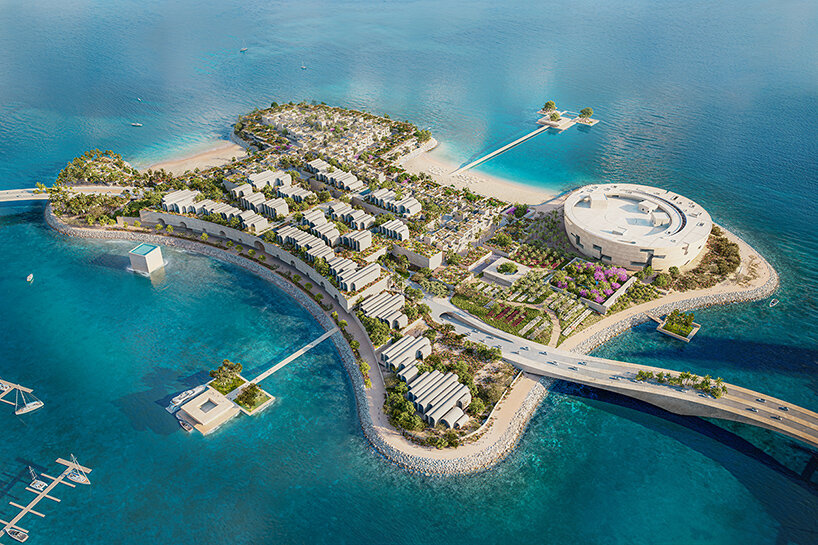
Unveiled at Art Basel 2026, the project transforms a 230,000 m² artificial island off Lusail into a cultural and residential district anchored by the Lusail Museum.
Herzog & de Meuron has unveiled the masterplan for Al Maha Island, a 230,000-square-metre artificial island off the coast of Lusail, Qatar, created in 2022. The presentation took place during Art Basel 2026 in Basel, led by Jacques Herzog, Her Excellency Sheikha Al-Mayassa bint Hamad bin Khalifa Al Thani, and Noah Horowitz, CEO of Art Basel.
The project reimagines the site as a premier cultural and residential district where contemporary architecture, art, design, gastronomy, and community converge. The masterplan encompasses the Lusail Museum — a spherical volume designed by the Swiss firm and future permanent home of Art Basel Qatar — alongside a contemporary souk, gardens, restaurants, a boutique hotel, and a series of waterfront villas, hilltop residences, and townhouses.
First presented in 2024, the Lusail Museum will become the cultural anchor of the island and of Lusail as a whole. This world-class institution will serve as a platform for cultural diplomacy, offering a dynamic environment for dialogue on the historical and contemporary exchanges that shape global culture.
"When the museum was first presented, it was in a different location, but because of the purity of the building and the importance of the collection, it was moved to Al Maha Island. This is one of the few places where foreigners can purchase homes and land; that is why we developed the entire island as an ecosystem of residential areas, a boutique hotel, and a small souk that blends modernity with tradition."
Sheikha Al-Mayassa bint Hamad bin Khalifa Al Thani
Shaped by Qatar's History, Landscape and Vernacular Typology
Located near the historic area where Sheikh Jassim bin Mohammed Al Thani, founder of modern Qatar, established his home in the late nineteenth century, Al Maha Island represents a contemporary vision deeply rooted in the region's heritage. Across a masterplan whose construction is projected to begin in 2028, Herzog & de Meuron draws on vernacular typologies and a distinctive architectural language for the island's residential, commercial, and cultural districts.
Regional traditions are woven throughout the design: courtyard houses and townhouses connected by narrow, shaded streets, walled gardens, and monolithic earthen structures that appear to rise organically from the ground.
"The island is man-made, and building a piece of city here has a completely different meaning. We wanted to incorporate that into the concept: to build with local materials — sand and rock — so that it feels like a whole, not something we brought from outside."
Jacques Herzog
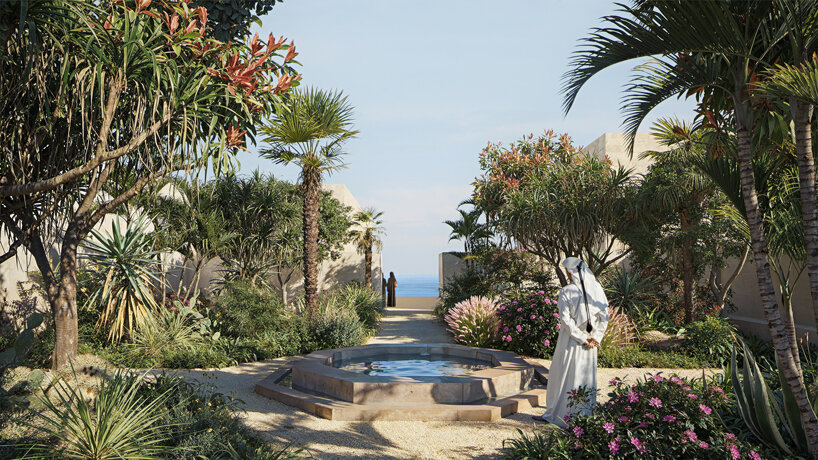
Nature is central to the experience of the island. A series of jewel gardens is precisely integrated into the landscape, creating moments of contemplation and natural focal points. To revitalise native ecosystems, the programme will work alongside local nurseries and initiatives focused on indigenous species.
"A garden must be as specific as each building. We cannot turn this into a golf complex — we have jewel gardens surrounded by a more traditional landscape than what is cultivated in Doha. Every fragment of nature must be integrated with precision."
Jacques Herzog
The Arabian oryx — Al Maha — native to the peninsula, will also be woven into the landscape experience of the project. "Al Maha means oryx in Arabic, and the oryx is the symbol of our national airline," said Sheikha Al-Mayassa. "Without Qatar's conservation efforts, the species would be extinct — and that is something we are very proud of."
Waterfront Residences and a Permanent Home for Art Basel
Connectivity with Doha and Lusail will be provided by water transport, alongside dedicated vehicular and pedestrian bridges. Thanks to the island's gently elevated topography, all infrastructure will be routed underground, ensuring a traffic-free pedestrian surface with unobstructed views across the water and surrounding reefs.
The residential programme will comprise more than 150 units — waterfront villas, hilltop villas, townhouses, and apartments — complemented by a boutique hotel. Each year the island will host Art Basel Qatar, the most significant recent addition to the country's cultural calendar, following its inaugural edition this past February.
Rather than confining the fair to conventional exhibition halls, the vision for the permanent exhibition space encompasses the entire island. Planners envision the access bridge as the fair's entrance gate, transforming the broader ecosystem — including local restaurants — into an immersive, island-wide experience.
"We are very excited about this co-creation. We are not just connecting with something that already exists — we are working alongside our partners to build something new. Following the cycles of our industry and forging deep connections with new regions, artists, and institutions is among the most exciting things we can do."
Noah Horowitz — CEO, Art Basel