



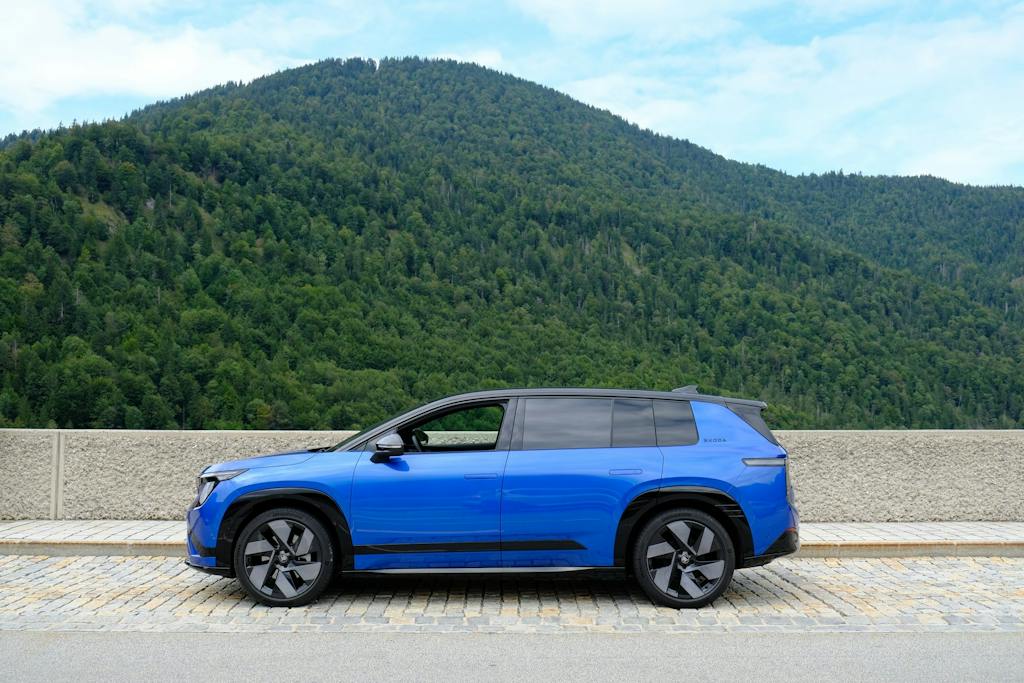

Last week we published my review of Škoda’s new Epiq. This week we’re doing a design review of the Peaq. Trust me though, this isn’t turning into the Skoda fanboy website. Even if, personally, I’ve always been supportive of the firm’s long term approach to creating cars that Do A Job But In An Interesting Way.
Like the Epiq, the Peaq is an everyman/everywoman/everyperson (plus five kids and a dog) kind of car. Just a lot bigger and at the other end of the size scale. It’s going to cost you more than an Epiq, but at £52k for starters from Škoda UK, it gives you a proper, full-sized seven-seat layout for roughly 60% of what BMW asks for a five-seat iX – and comfortably undercuts huge three-row EVs like the Kia EV9. It’s a space efficient design that can still take a family and two grandparents for a day out.
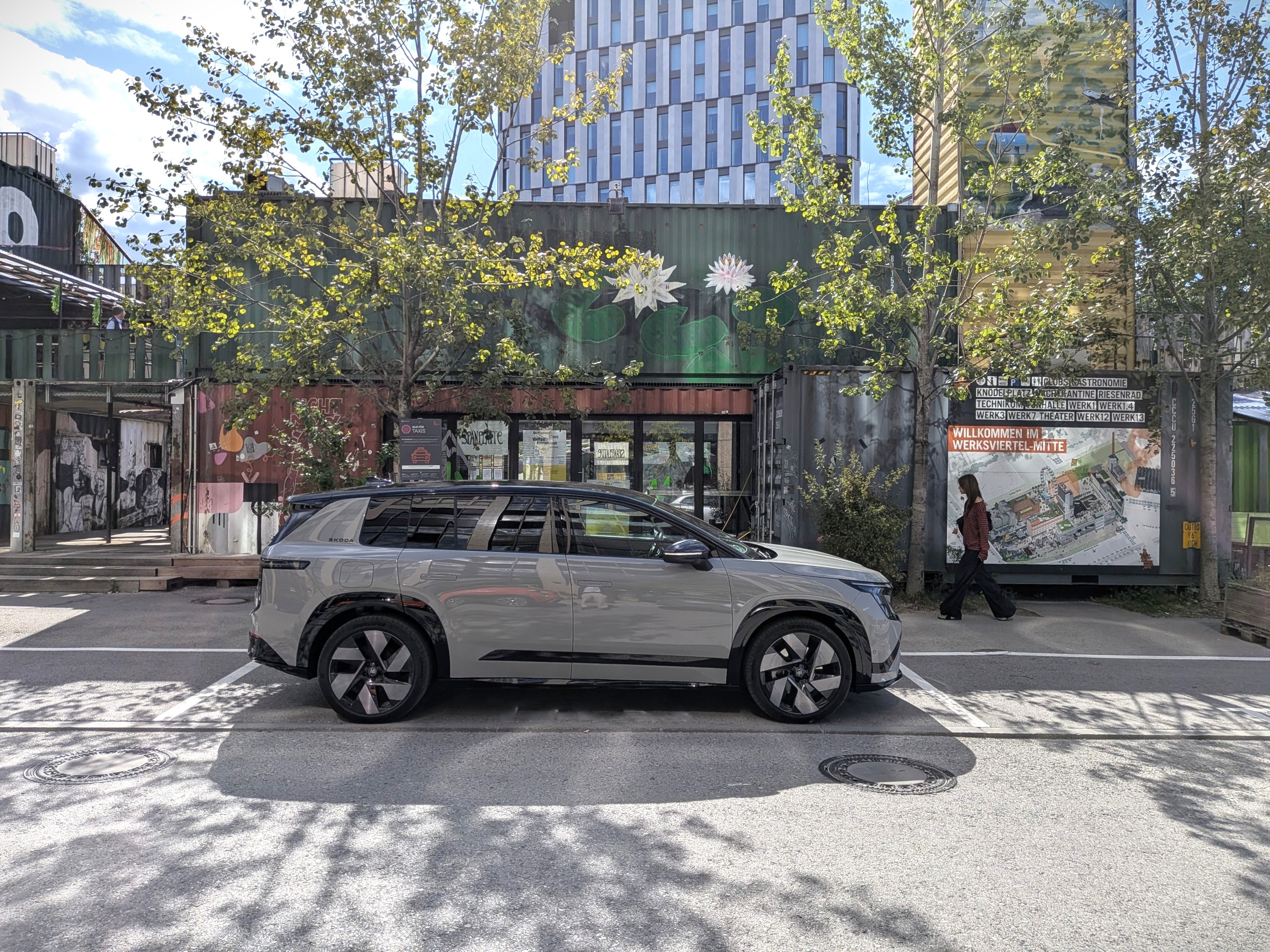
It’s not going to scare your friends as you exit the business of Edge Lane and power up the ramp to the M62 with its performance – but trust me, if they’ve ridden in a few quick electric cars they’ve probably already had enough of squirty electric power and are going to be more interested in other things. Does it look good? Is it nice inside? What’s the ride like? How does it drive in normal use? What does it cost?
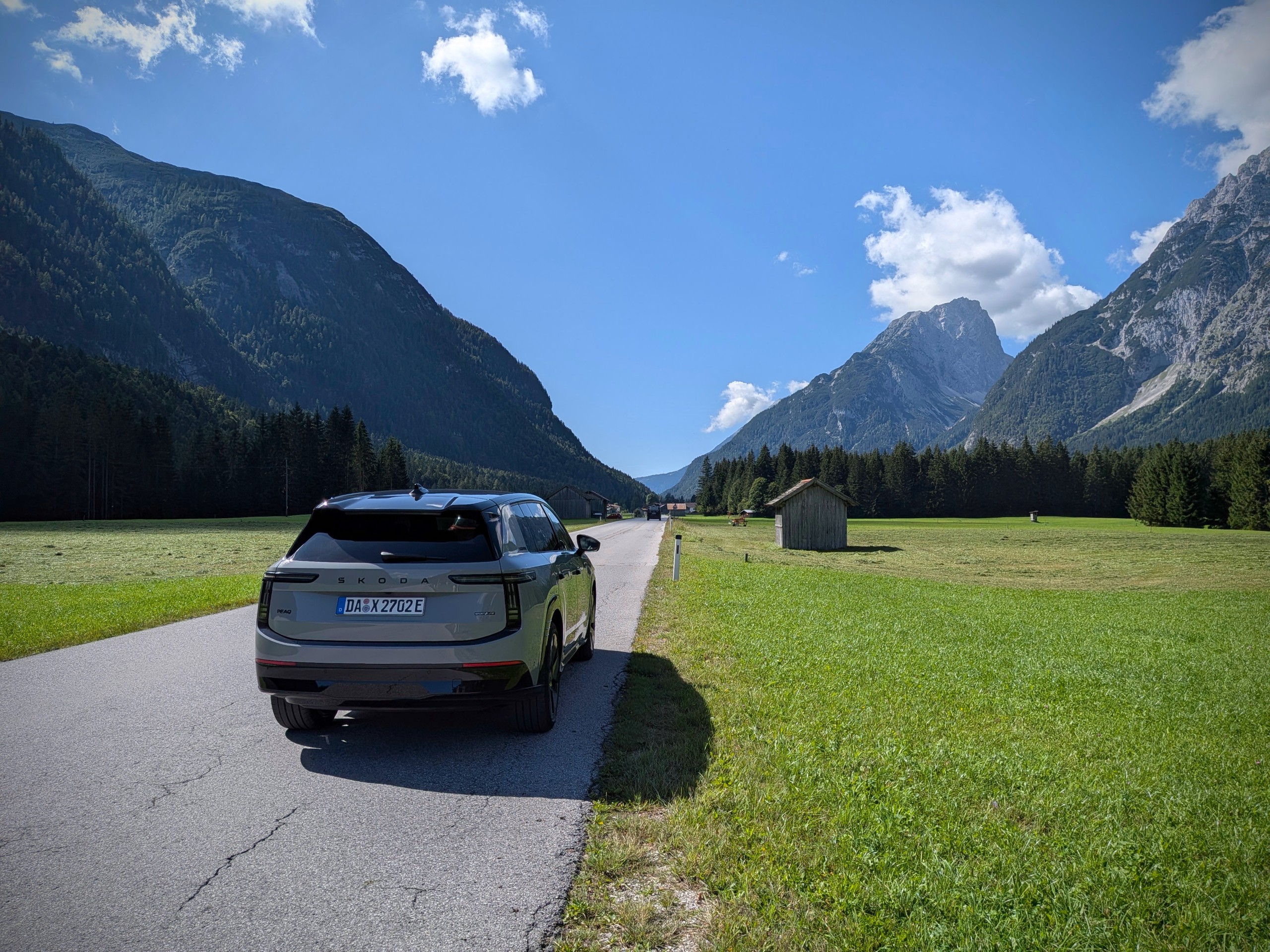
This is the reality of Škoda’s approach – 99% of the time you’re not powering around a race track or accelerating hard onto a motorway. But if you’re as lucky as I was to find myself on Tyrolean roads with big drops, then you’d like the car to feel competent enough that you feel safe, comfortable and certain that it won’t try to pitch you over the crash barriers.
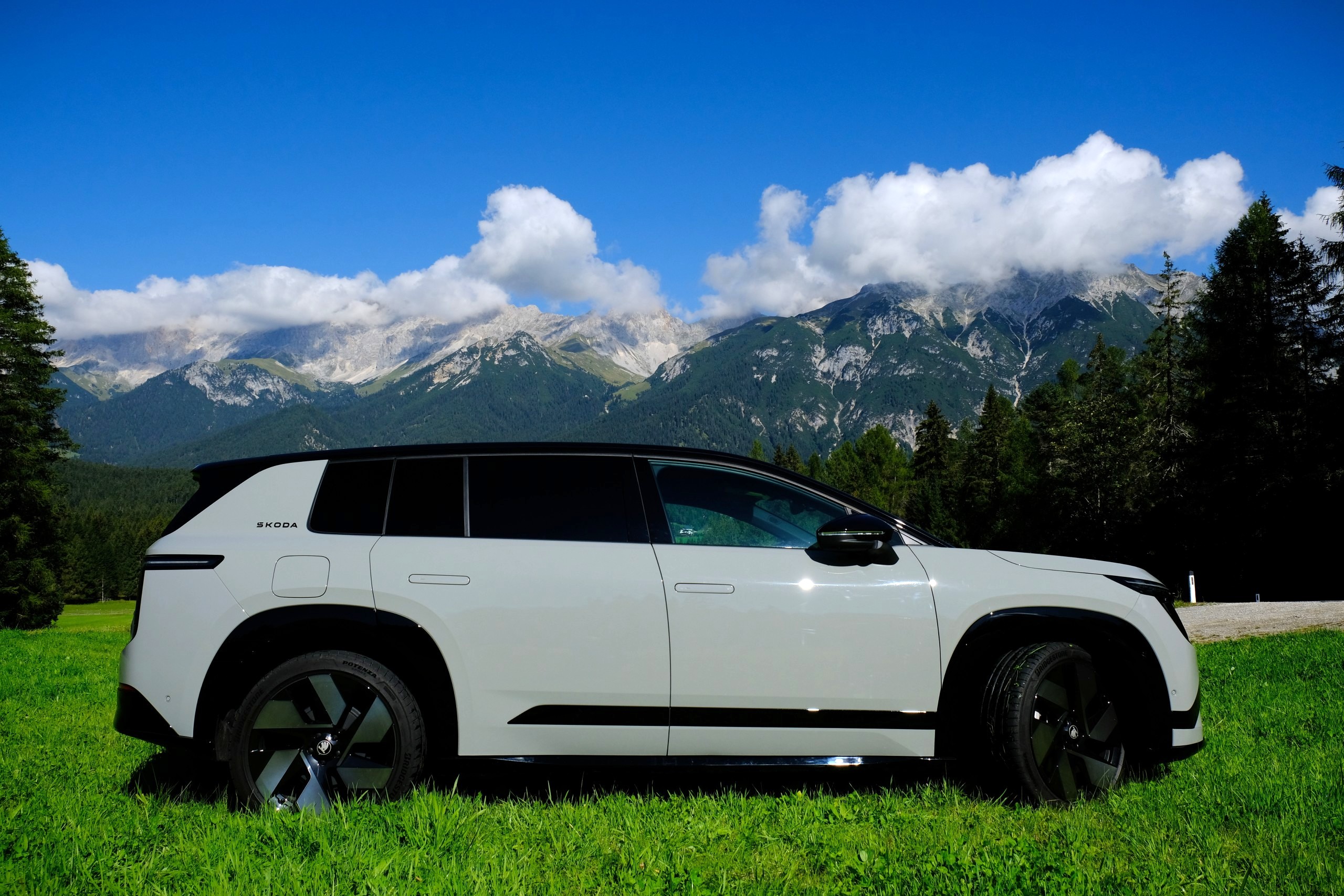
The Peaq uses Oliver Stefani’s Modern Solid philosophy along with its much smaller sister car. It’s a grown-up style, and one created to work equally well on smaller saloons as it is on large, heavy-fronted electric SUVs.
If we didn’t have these multi-part front ends and stuck to the relatively simple design language of the past but tried to apply it to modern car proportions, they’d look a bit mad. For fun, I’ve tried to apply a couple of past Škoda design languages, with AI, to the Peaq’s body shape.
The results did not look good. The output looked either dumpy and startled or oversized and a bit American.
Realistically, it’s impossible to apply old-school styles to modern proportions. And this is a problem that many car designers have wrestled with – how do you build an aerodynamic and interesting front end without things being either bland or overly massive-looking? If you’ve seen some recent BMW SUVs and the backlash they faced, you’ll be well aware that it’s a tricksy problem to fix. There’s the secondary problem of who you’re designing for – the Chinese middle classes love a big grille, so if your design is going to sell there, the front end of a car has to shout.
Yet the reality is that Škoda has been exiting China following a local price war they couldn’t compete within. This means that their design is now focussed on Europe, India and South-East Asia – markets that have very different tastes. Whilst the new Epiq won’t be heading that way, the Peaq is.
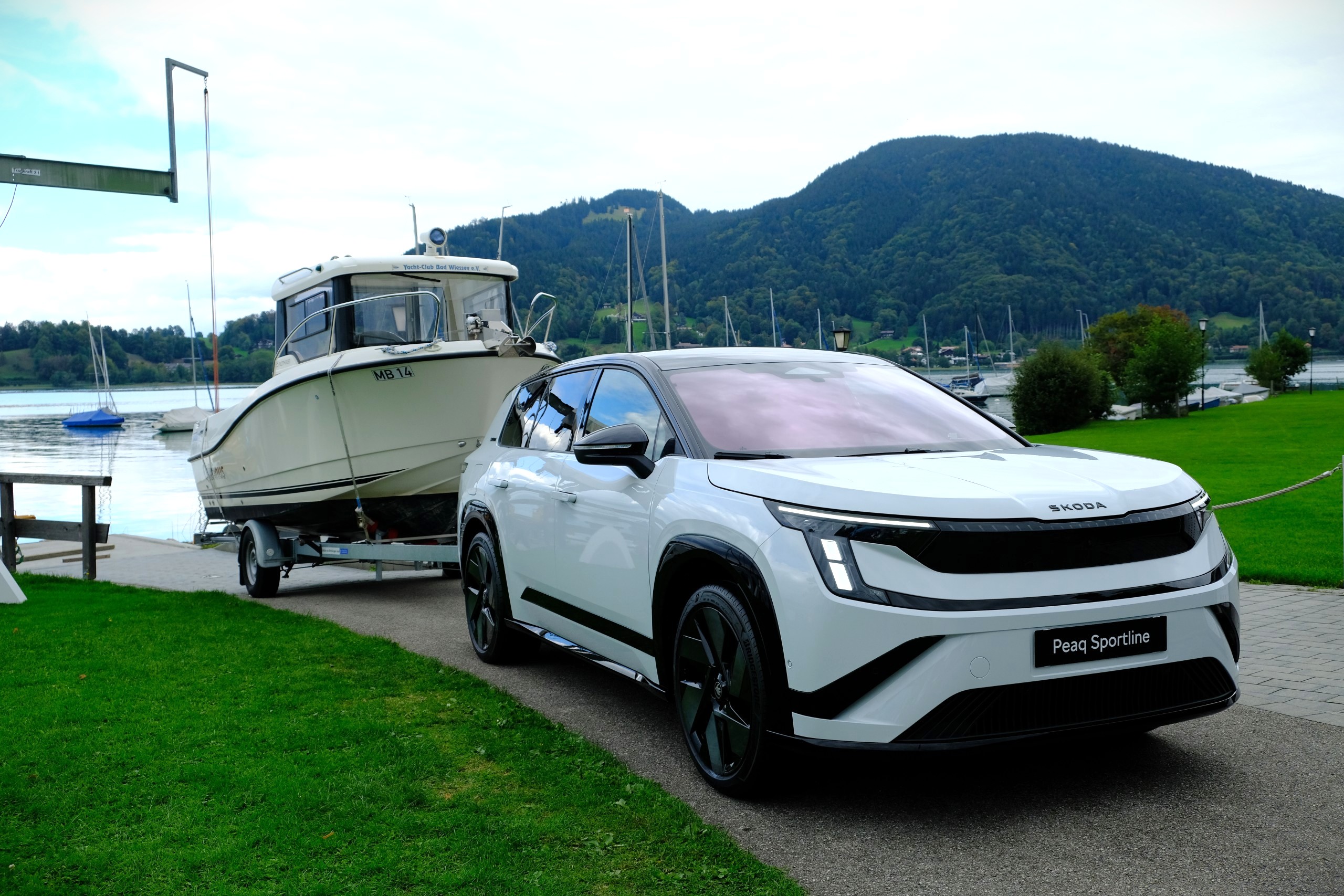
This allows for a design that’s a little more grown-up to European eyes. But at £52k to start – and pushing over £60k for the Sportline edition I drove – restraint can’t look plain; it has to look deliberate. Without a massive grille or theatrical styling cues to rely on, every surface has to work harder.
A polite and slippery exterior
Škoda’s team was very keen to point out that the drag coefficient (Cd) of the car is 0.249 – which is exceptional for a car that you might initially see as boxy and big.
This is largely down to clever detailing and aerodynamic work – with active elements at the front of the car, careful optimisation of the airflow under the body with air deflectors and curtains to carefully manipulate airflow. In fact, everywhere you look at the exterior you can see little details designed to move air in the most effective way across the body.
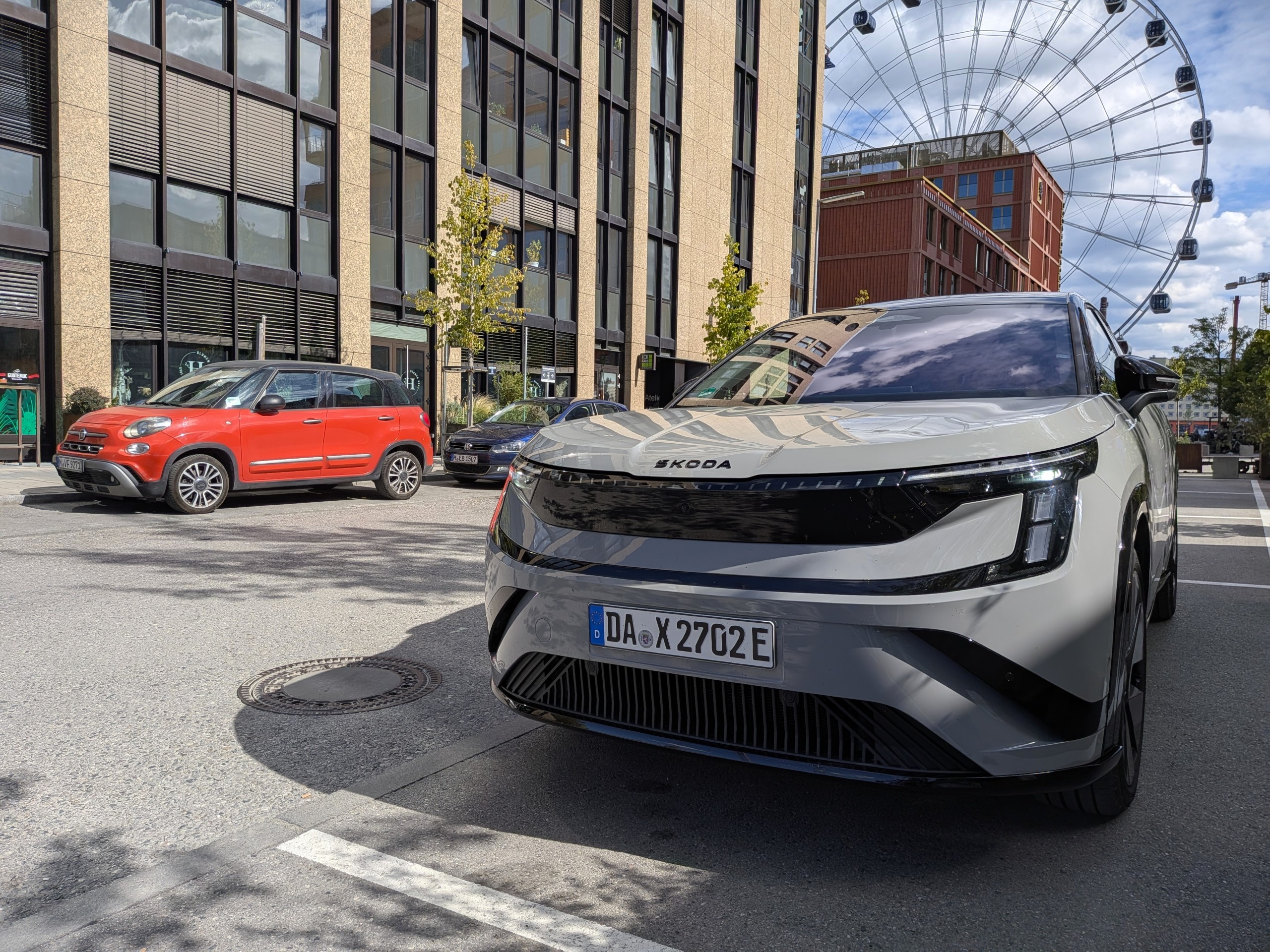
This could easily end up looking ugly, but the design team worked out a way to lighten the flanks without using an excess of crease lines or gimmicks. They were led by Oliver Stefani, who said:
“Minimalism and the human approach are the guiding principles – every shape has meaning, every line has a clear purpose.”
Of course, few designers would say otherwise – I don’t think I’ve ever asked about a line, a flourish or a detail and had one say “because I felt like it.”
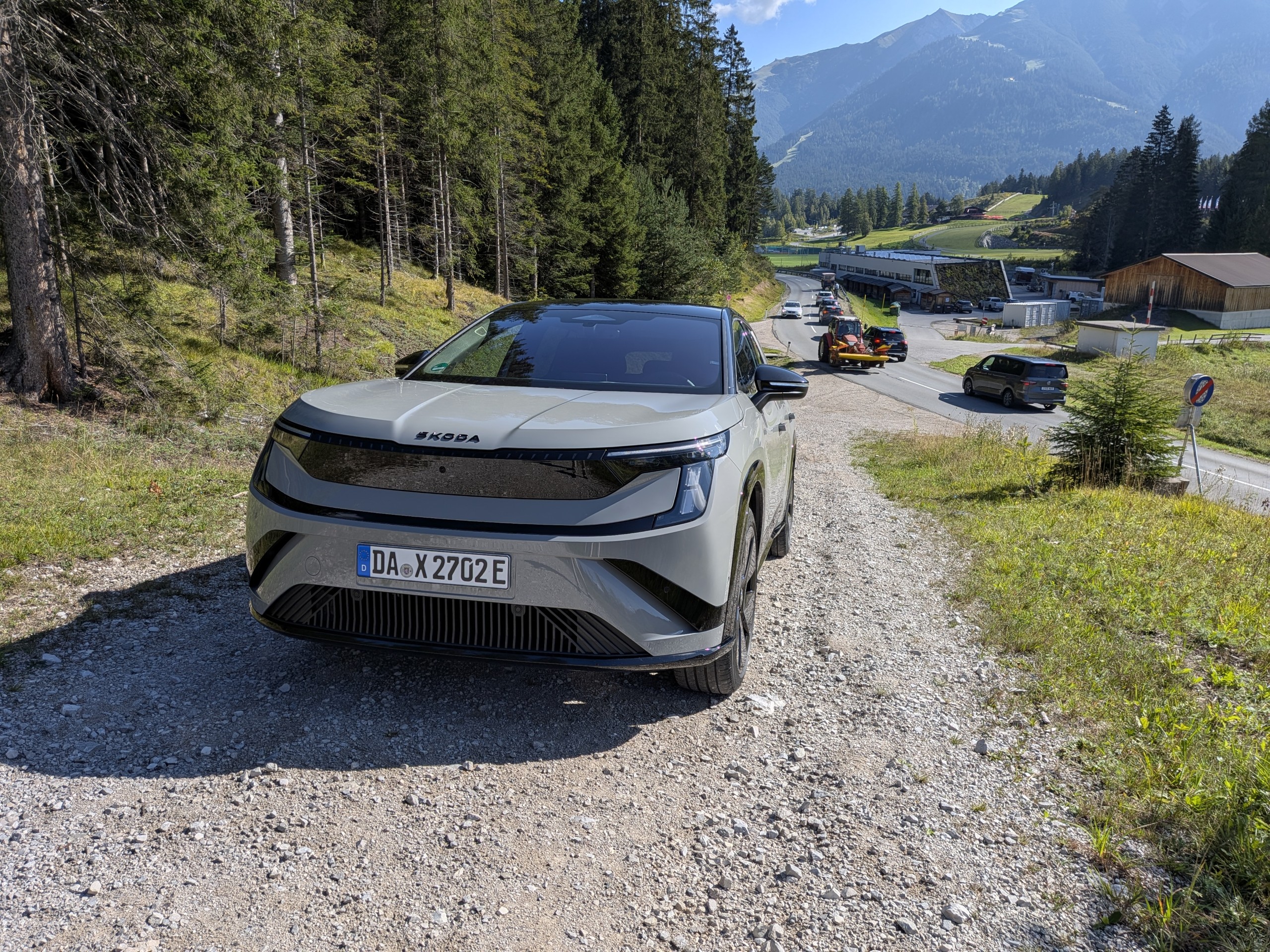
The Peaq’s exterior feels functional but tight. It’s shaped for space and aerodynamics with its steeply raked screen, and styled for gentle confidence. At the front, the Modern Solid Tech-Deck way of Škoda’s styling doesn’t give it the ‘f*ck you’ stance of a Range Rover, or the startling emptiness of a Kia EV9. It just feels… grown-up. Confident.
The Modern Solid design philosophy manages to create a very neat and tidy car that has details that could easily end up looking fussy but don’t. There are some nice touches – the way the lines of the front bumper then link into the side strip, and how the front lights extend back and point directly to the lines of the rear lights that extend forward… that’s fine work. It’s subtle, classy, and lifts the side view in a way that puts it ahead of the upstart firms.
The door handles are flush – it’s a good idea for aerodynamics, but after I’d stopped for photos I came back to drive only to find the door handles had retracted. This led to a moment of concern, because the keys were inside the car still and I was outside. Awkward. I poked the handle. Nothing. I poked it somewhere else, hoping it would respond to my touch. In the end I tried pushing a little harder at one end, and that sprung the handle out enough for me to pull it and open the door.
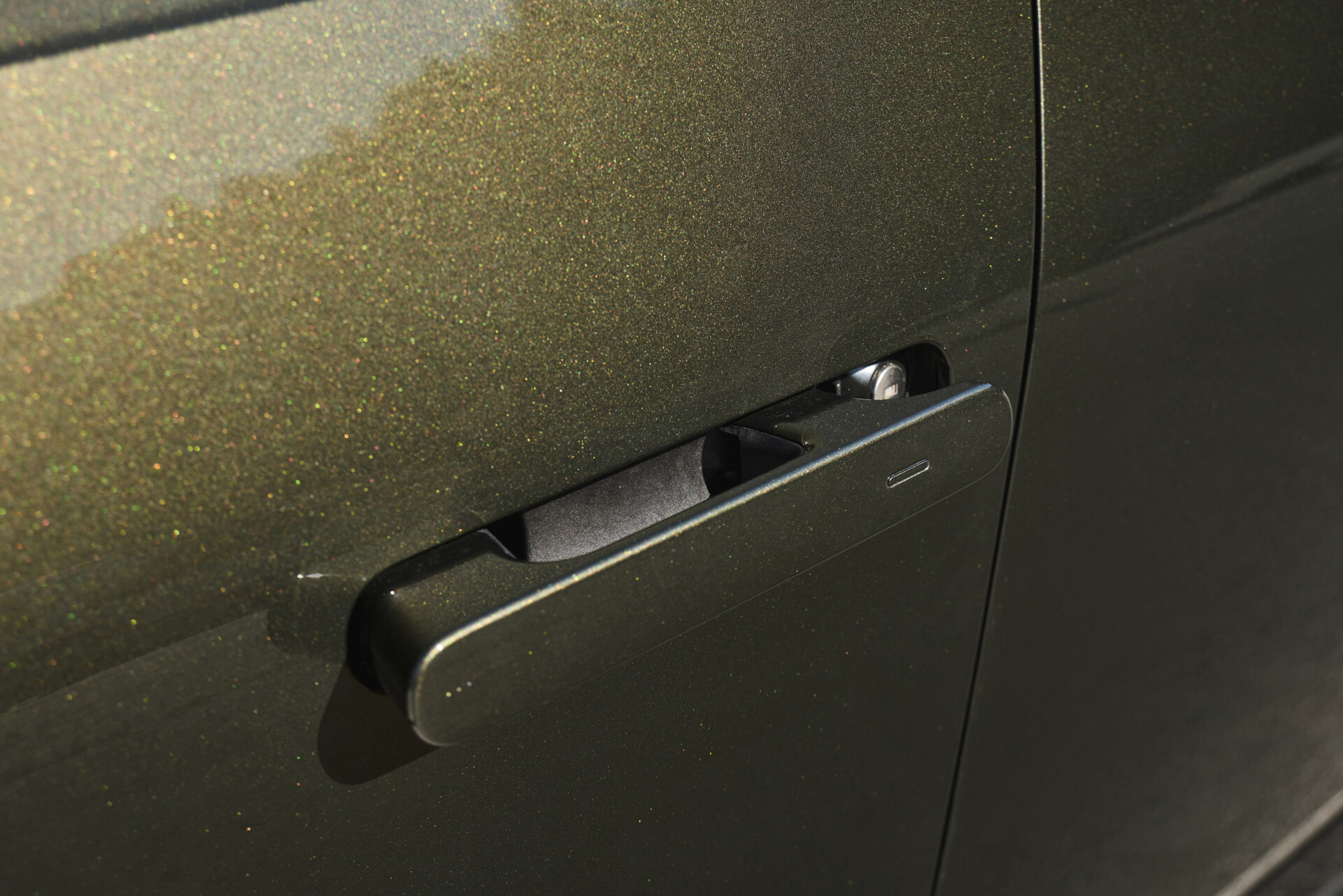
Taking several seconds to realise how to get into a car is hardly a problem, and it’s a once-only experience. If you’re being normal and have the keys in your pocket you can always get the handle to pop out at will by pushing a button. It’s an ergonomic trade-off for a slipperier shape.
My car looked fine enough in grey, but it’s a very boring colour. There are, thankfully, a few actual colours you can have your car in – Race Blue Metallic is a nice, mid-tone blue at no extra cost, or you pay £410 extra for a red, green or, the one I think will be very popular, the Rosewood Metallic. Some men will feel it threatens their masculinity. Some men need to admit it, they like it. That there’s no crime in giving yourself over to pleasure.
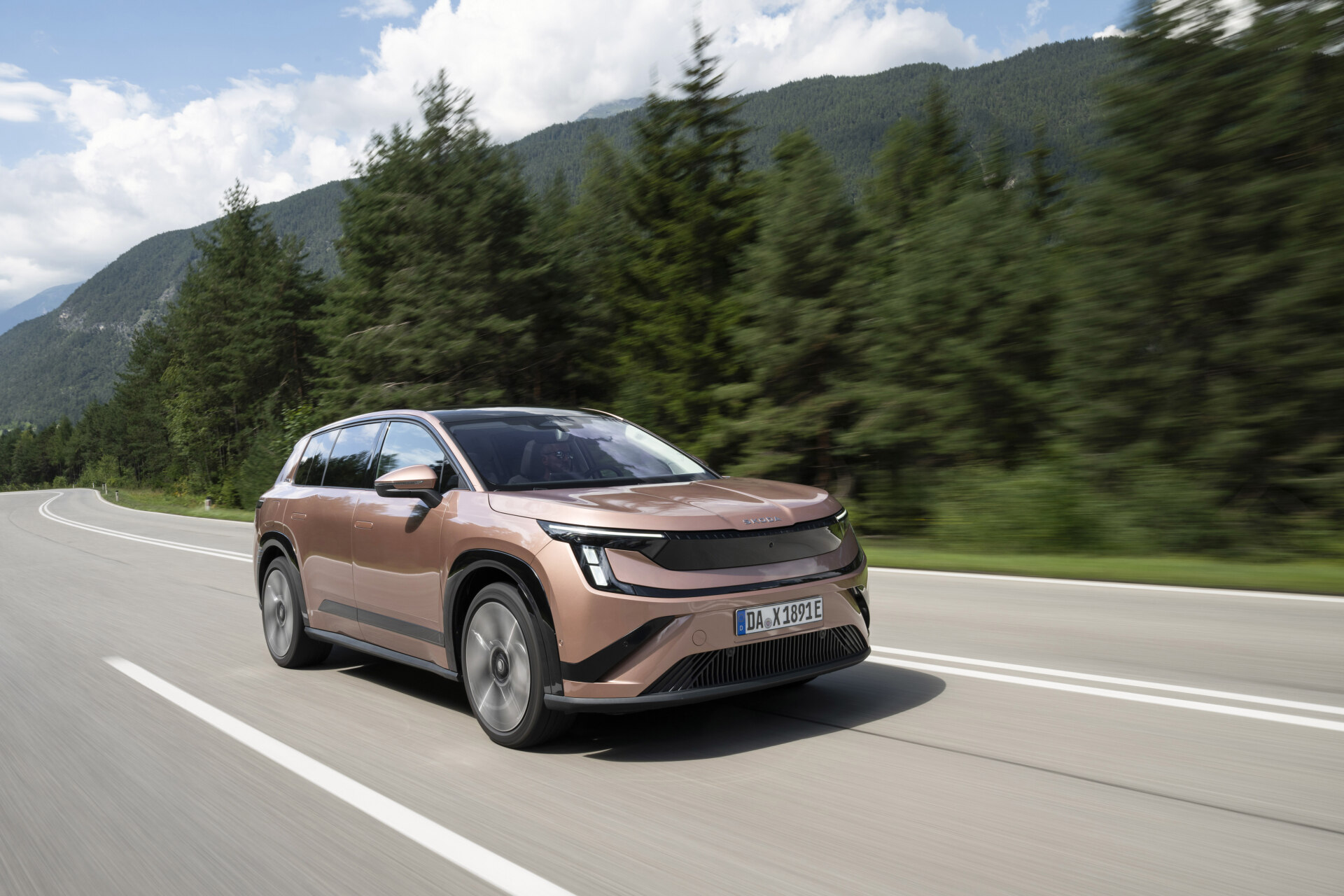
I think I’d have liked the LED Matrix headlights too, but I didn’t get to drive in the dark to see if I did or did not blind oncoming motorists, pedestrians and cyclists. The principle is good, but the principle behind LED lights is good until you drive an old, low car.
I’m not going to say much about the driving experience beyond the simple fact that it’s grown up. My car came with adaptive suspension which is A Very Good Thing for ride comfort whilst retaining very grown up handling. And the four wheel drive option gave it solid traction out of mountain hairpins but also allowed me try climbing a steep gravel path. Which of course it did perfectly well. Because it does everything perfectly well enough for normal people doing normal car things. And the suspension absorbed the bumps well.
Interesting fact – most Germans specify adaptive suspension. Very few Brits do. We should – our roads are rubbish. It allows the suspension to be soft when you need it to be, but to stiffen up in emergency manoeuvres or when you’re getting a bit helmsy on faster roads.
Spacious and comfortable interior
I’ll get my one big complaint out of the way now – my car had the Sportline trim level, which meant it came with firm, sporty seats that wrapped around you and even had a pseudo-harness slot. They’re unnecessary. Yes, they hold you well when you’re making the most of the performance and handling on mountain roads, but it’s a comfy car. Let’s keep the seats comfy too.
Which is why I’d rather have a car with what they call the Relax package – ergonomic, heated massaging seats with a leg rest and a folding table. You’re tired, you need to add some range – perfect for a twenty-minute charge stop and nap.
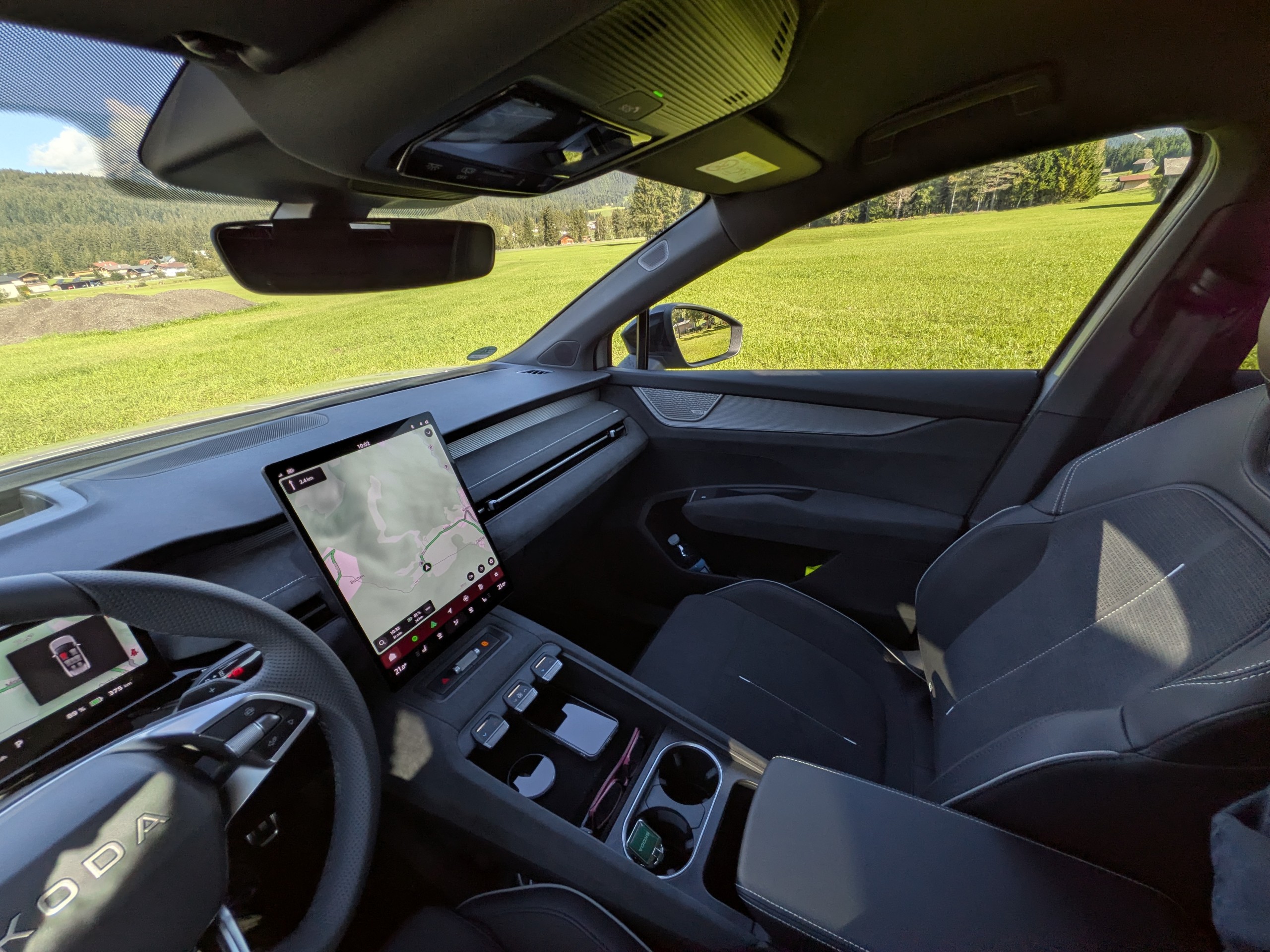
The interior I was given was called “Coalmine” on the spec sheets… oh hang on… no, it was called “Sportline Grey.” The exterior was also grey. A lot of people are grey people and prefer grey cars with grey interiors. I don’t get it. It’s like millions of people settled down to watch Melancholia and thought “yep! That’s my life! I will express this with my choice of car colour.” It’s not that dark interiors don’t make sense in cars – they don’t reflect awkwardly on the windscreens, for example. But living in the wild North of England I appreciate a bit of lightness now and again.
All the surfaces were pleasant and a lot of the interior on this model, other than the dashboard top, were covered in a fake suede that worked very nicely. It’s called Suedia, feels nice and no cattle had to die for it. Other models get the same Tectona vegan leather-ish material that you find in the nicer Epiqs… this is no bad thing – it’s a good material in its own right that is delightfully tactile. Eventually Škoda will have an option for leather, because for some, the merest mention of vegan will be a step too woke.
The overall structure, style and feel of the interior then is very pleasant. Everything works.
Hiding three usable rows inside a shape with a 0.249 drag coefficient is where the real packaging magic happens. Thanks to a sprawling, nearly three-metre wheelbase, the third row doesn’t feel like an afterthought or a punishment slot for underbehaving teenagers. Crucially, the team carved out that cabin volume without giving the exterior the tall, slab-sided ‘brick-on-wheels’ profile that plagues so many seven-seat electric SUVs.
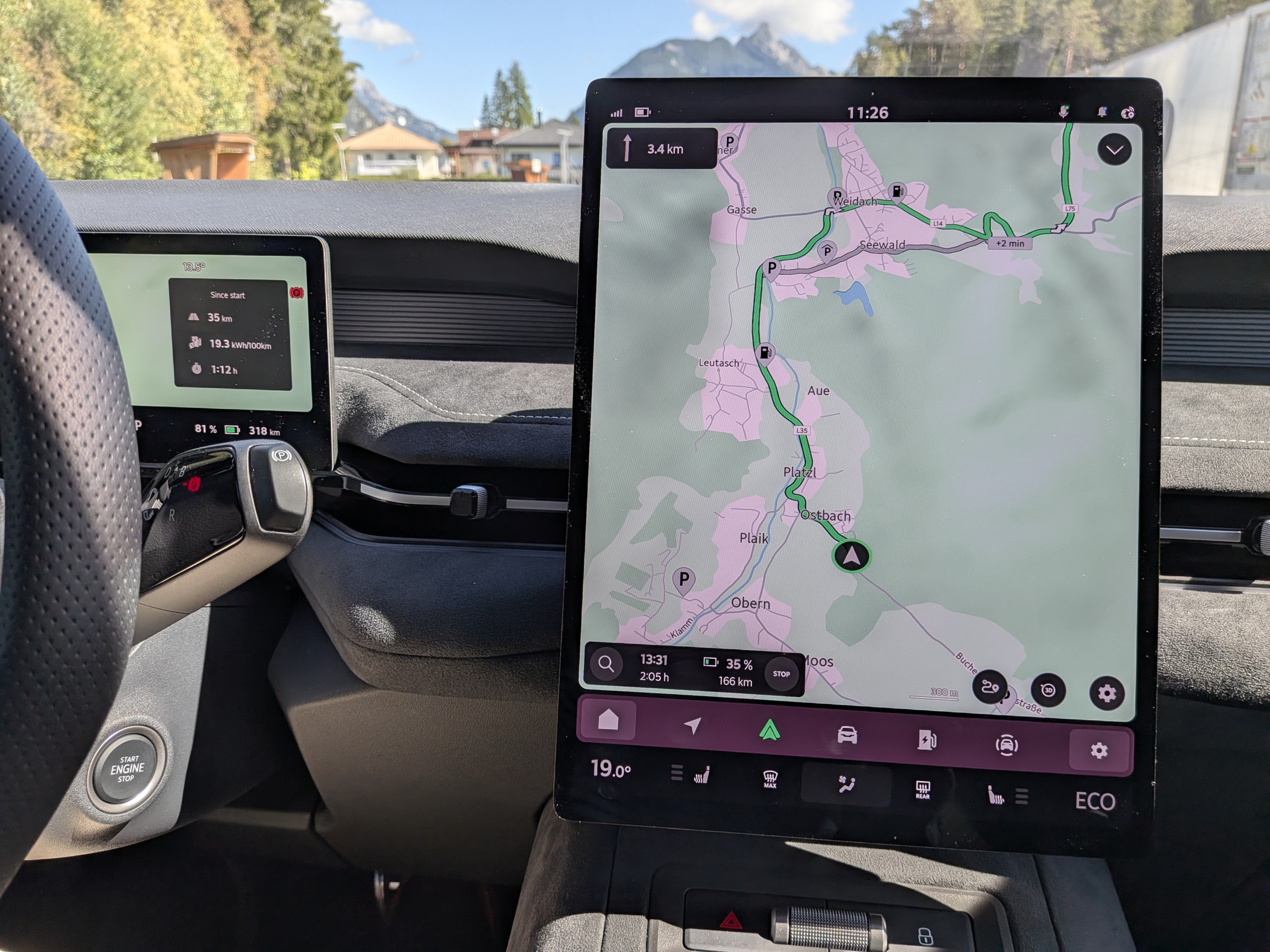
The UX on the HMI system, whether the central tablet screen, the driver display or the head-up display (HUD) – it all works together in a tidy way. I quite enjoyed having the map shown on the driver display with glowing arrows floating above the road ahead. It all worked well and helps reduce the number of missed junctions.
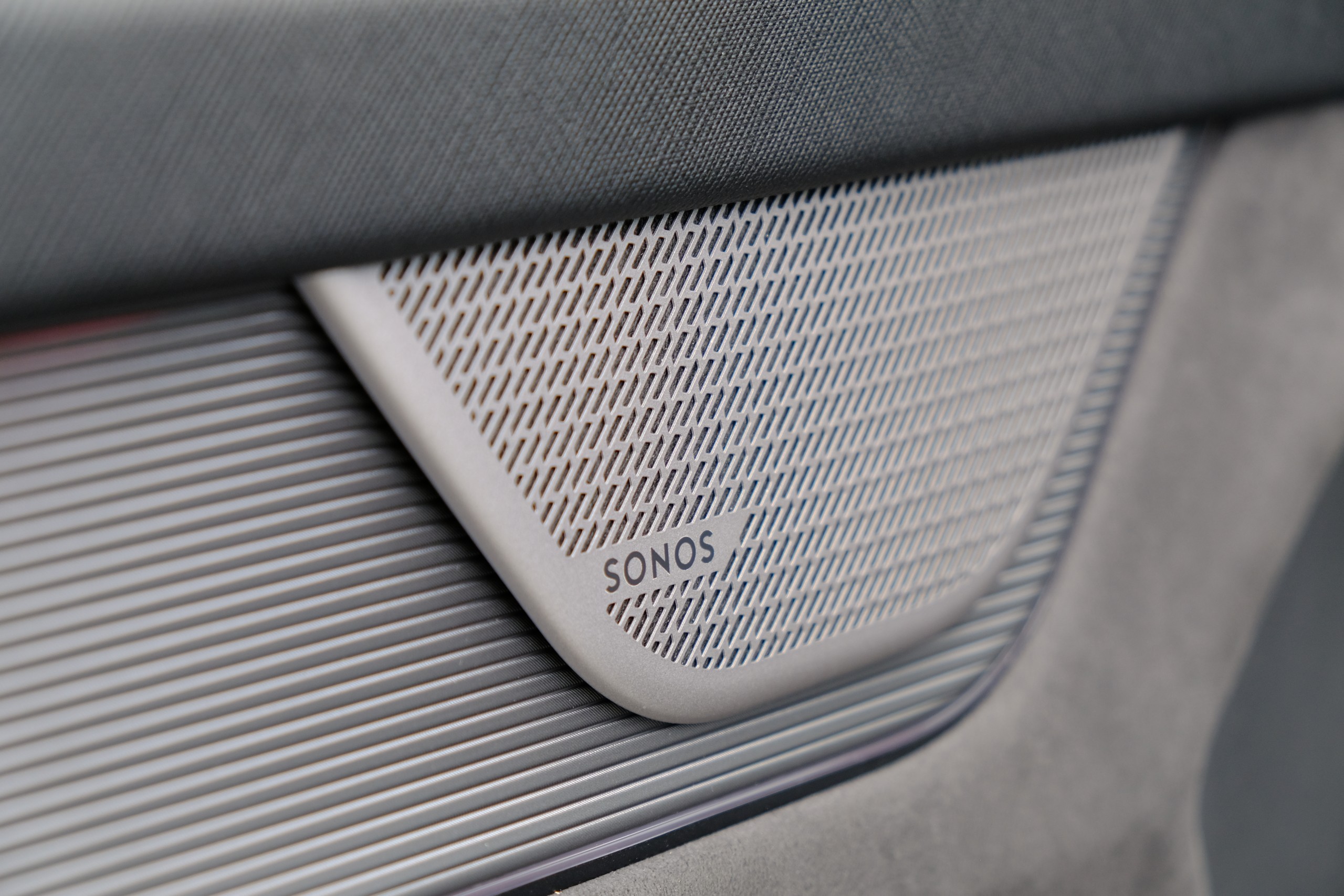
And the sound system itself works very well – the Sonos derived system has 700W of power to play with, which meant that Massive Attack’s Angel, with it’s deep sub-bass, made the rear view mirror vibrate so hard the outside was blurry. Yet it also gave a broad soundstage when I played another tune from my test playlist, Bubbles by Yosi Horikawa. At one point I realised that the system’s smoothness was leading me to play music far louder than strictly necessary – especially in a very refined, quiet car.
A nice final touch, that isn’t so much aesthetic but functional, are the two MagSafe charging points in the centre console. You just snap your phone in and you’re good! The phones are held securely, charging, and connected via Apple CarPlay or Android Auto. I didn’t use Android Auto for the sat nav because the built-in system is really good and well integrated, but I did use it for testing the sound system.
Conclusion
In any design process, there comes a point where you simply have to say ‘enough’ – to stop tweaking, step back, and accept the reality of creation. I often wonder if modern car design teams know when enough is enough.
The Peaq gets it right. It delivers enough performance, enough design restraint, enough comfort, enough range, enough towing capacity, enough style, enough charging speed (199 kW by the way) and enough spatial intelligence to make you feel like you’ve done quite well enough in life whilst still being fairly careful with money. It’s a car for people who are secure enough to want something genuinely good, without the need to shout about it – and if you ever do feel the urge to go recklessly fast, it will happily tow your track car behind it.
If I had the budget for a family car of this size – about £58k in the spec I’d like, or about £550 a month on a business lease – wearing either my design-hat or my driver-who-tows-a-racing-kart-trailer-hat I’d certainly put this car on my shortlist for consideration. Would I recommend it for designers? If you have a large family or a lot of stuff to carry around with a little big of panache then yes, of course.
Become a Design Week member for £4/month or £40/year
Already a member? Sign in.





 Estudio EA