



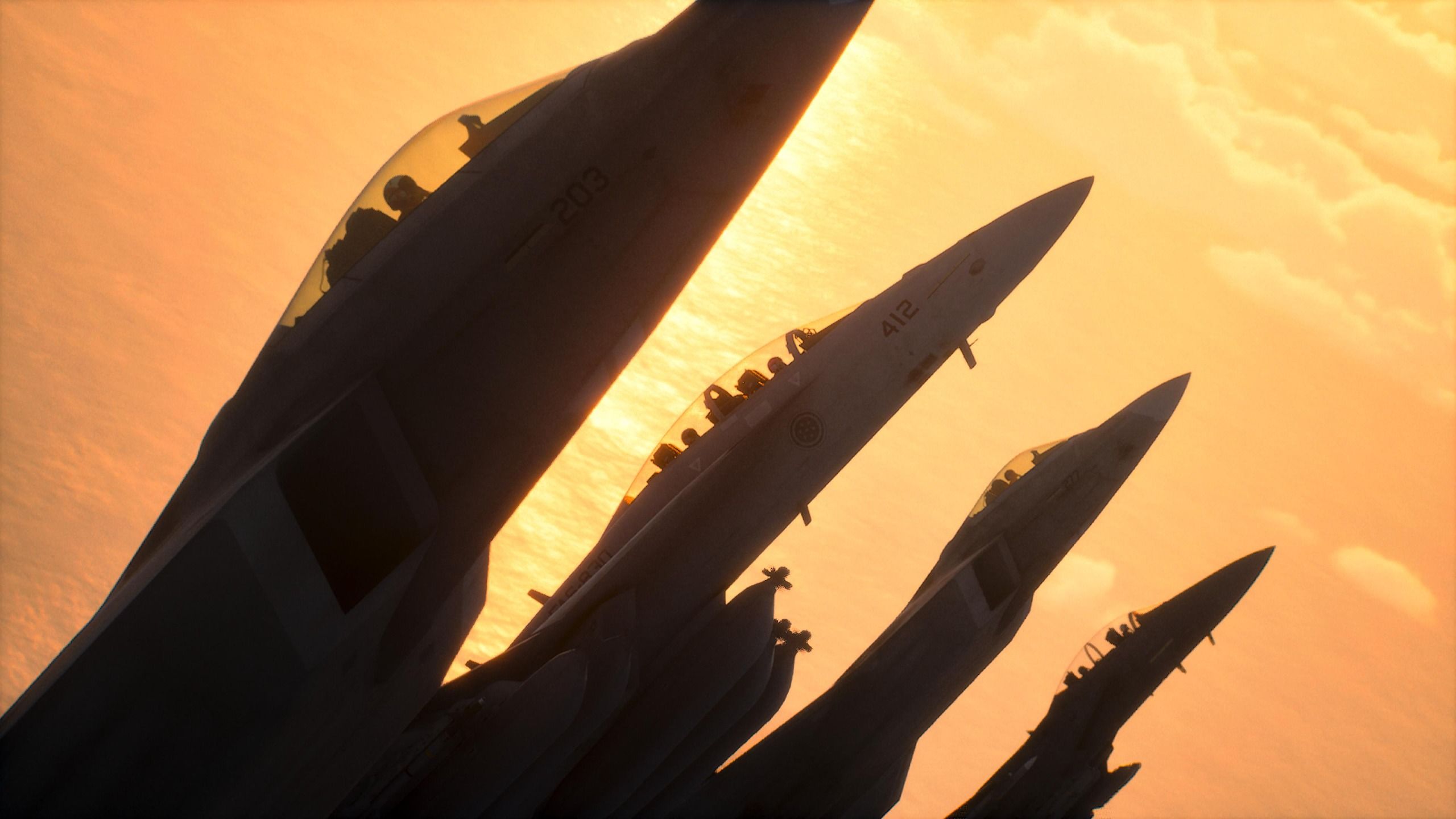
Ace Combat 8: Wings of Theve (PS5) review – bigger skies, more drama, same old rhythm, and I’m mostly fine with that

Why you can trust Creative Bloq
Our expert reviewers spend hours testing and comparing products and services so you can choose the best for you. Find out more about how we test.
Details

Publisher Bandai Namco
Developer Project Aces
Release date 2 October
Format PS5 (reviewed), Xbox Series X|S, PC
Platform Unreal Engine 5
Crisp blue skies, real-life planes modelled to every nut sitting alongside hyperactive anime heroes and sci-fi flying fortresses – oh yes, Ace Combat 8: Wings of Theve is the most Ace Combat-y of Ace Combat games, and from takeoff it’s not really interested in being anything else. If you’re here wondering if Project Aces has finally decided to reinvent what it does, well, it doesn’t, and about six hours in, I didn’t really mind.
Ray-traced clouds, a new war, the return of squadron orders you can bark at your wingmen mid-dogfight (well, via the D-pad), and for a while I waited for the moment the formula cracked open and did something really new. It never quite does. Lock on, cycle targets, cycle weapons, fire – Ace Combat’s been running that loop in these blue skies since 1999 (for me, the series true self started with Ace Combat 3: Electrosphere), and Ace Combat 8, for all its polish, is still that loop wearing a nicer flying jacket now joined by teammates.
That’s not really a complaint, because it’s comforting to return to what it’s like to play a game from a developer that understands what’s needed, and when it works – and it works often – Ace Combat 8 is still a wonderful, faintly ridiculous flight of fancy, with controls easy enough that you spend most of a mission looking at the sky instead of worrying whether you’re flying it correctly, right up until a flying mega-wing-thing the size of a city block rises over the horizon and you remember exactly what game you’re playing.
The story, such as it is, hangs a fresh look on that old formula, as it’s not in first-person: 2029, the Federation of Central Usea overrun, its navy shattered, and you aboard the ageing carrier Endurance, where a propaganda unit has turned a legendary pilot called the Wings of Theve into a rallying myth – except the legend was never real, and somehow you inherit the name anyway, flying with Baxter, Tasha and Coster as Joker Flight while what’s left of the FCU tries to take its home back. It’s Ace Combat doing what Ace Combat does: a war story about borrowed identity, the underdog doing what’s right against the odds, mostly as an excuse to strap you into increasingly swift and agile fighter jets.

(Image credit: Bandai Namco)


Wings of Theve, and one thousand aircraft against your four
Like previous entries, the spectacle is where Ace Combat 8 earns its keep, because just as a mission starts feeling like another exercise in target practice, things shift a gear and a new mini-boss, an elite squadron, a change of objective, the horizon suddenly fills with something enormous or numerous, and Project Aces throws the next thing at you, usually a massive flying wing or ‘land ship’, and the soundtrack swells dramatically, convincing me that whatever’s sitting at the far end of my lock-on reticle actually matters.
While Ace Combat 8 plays a little coyer with its biggest moments than Ace Combat 7, saving the real spectacle for later, when it arrives, it arrives properly: the space elevator returns, scaled up further still, and one of the best missions in the game puts you against a Land Battleship – a destroyer bolted onto tank treads – as it tries to ram and bring down the iconic megastructure, and you pick apart its armour plate by plate before it can fire again.
This is exactly the sort of setpiece event that sounds like nonsense but feels fantastic in flight, and making use of Unreal Engine 5 mostly just means more of it – more aircraft, more bombers, more tanks, more explosions – right up to a finale when a radio operator tells you, with sincerity, there are a thousand aircraft against your four (I counted around 100 planes at one time, but more and more were added). I gulped. Then I grinned. That’s the whole review, really, if you want the short version.
What surprised me is how close Ace Combat 8 is willing to bring you in for a game that spends so much time at missile range with jets tumbling and rolling around each other until you’re watching the enemy aircraft rather than the battlefield behind it, which is where the series has always been at its best, better than any attempt to play this straight as a simulator ever managed. The new clouds help here and become more than eye-candy and emerge as genuine tactical leverage: they break line of sight, mess with missile tracking, give you somewhere to vanish when a dogfight’s gone wrong, and more than once I caught myself using weather instinctively to escape danger rather than simply admiring how good it looks rolling across a skyline and over mountains, and that backdrop finally feels like a place rather than a 3D-rendered diorama.

(Image credit: Bandai Namco)


Systems that promise more than they spend
This is also where Ace Combat 8’s attempts to grow up are more interesting on paper than they are in-game. Like previous entries, you have aircraft and special weapons to unlock, parts to fit, and MRP (Military Result Points ) to earn and spend. The returning squadron system lets you issue basic commands, like sending wingmen after targets, but it hasn’t really evolved since AC5 and is less complex than AC6. However, you can now spend MRP on them and not just yourself, adding a degree of tactical plotting through the aircraft upgrade tree, so when you call them back to cover you, they have the gear to make it work.
It feels like squadron commands should be a genuinely tactical layer sitting on top of the old arcade skeleton, but in practice, it rarely changes how I actually play. I leaned on a teammate to watch my tail a handful of times and enjoyed the couple of missions where directing the squadron actually mattered, but mostly I left them to it; your standard missiles will lock on and destroy almost anything anyway, and the special weapons settle into a familiar handful of ideas – long-range, multi-lock, auto-targeting bombs – by the campaign’s final third I was flying the same loadout I’d worked out hours earlier and never really questioning it.
Squadron orders are useful, and customisation is handy, but none of it breaks the lock-on-and-fire rhythm underneath, and maybe that’s the series’ whole compromise, really: push too far toward simulation and you lose the immediacy that makes this fun, push too far into pure arcade, and you lose the pleasure of actually feeling like an ace pilot, and Ace Combat 8 sits in that middle ground happily. Sometimes too happily – I let out an audible sigh hitting a stealth mission built around radar avoidance – but give me a sky full of fighters and a stupid objective, and I’m in love with how Ace Combat 8 feels. Ask me to creep around a maze of radar cones, and I start wishing it would just get back to the good stuff.
The campaign also weaves in something more personal, with new first-person interludes aboard the Endurance that bring you closer to the characters. And your performance, not raw decisions, shapes who survives, who joins Joker squadron, and who is there by your side for the grand finale, when every ally made along the way races to your side. Queue dramatic orchestral music as that pilot you faintly remember helping 18 hours earlier sweeps in from behind the clouds to save you. It doesn’t transform the storytelling, not really, but it gives the battles a bit more weight than the usual faceless setup because it could affect something.

(Image credit: Bandai Namco)


Bigger skies, actual humans
Then there’s the multiplayer, which might be where all those half-realised systems finally make sense, because *deep breath* online features a hundred-player Air Base hub, its own progression track, co-op missions, PvPvE, four-player Scramble runs against AI, eight-player superweapon raids, Co-Op Warfare that pits two four-strong teams against each other with NPC forces flooding the map, and Co-Op Assault turns it into a straight scoring contest. I only had limited time with it before review, so take this as a first impression rather than a verdict, but even my short play made one thing obvious – putting actual humans on the other end of the fight, and your aircraft and weapon choices matter in a way the campaign’s AI wingmen never quite do. Understanding positioning, cover, and roles means you have to watch your team instead of hunting the next lock-on. It’s a singular multiplayer mode, and there’s honestly not much else quite like it.
Which, in the end, is probably the whole pitch of Ace Combat 8. Project Aces hasn’t tried to reinvent anything here; instead, the team has taken a formula it’s spent decades sanding down, dipped back into fan-favourite ideas, and made the skies bigger, denser, prettier, and bolted on a unique dynamic narrative system onto these wings to make the old loop feel worth taking flight with again.
Is Ace Combat 8: Wings of Theve worth playing?
Sometimes I wanted more: the weapon system evolves from AC7 and promises depths it doesn’t deliver; the squadron commands could have been more effective; and here and there you can see the rails the game adheres to running behind the spectacle a little too clearly.
But then the clouds break, enemy aces come charging out of them, the score kicks in, half the sky goes up in flames, your allies arrive, and I remember what Ace Combat does better than almost anything else – it takes the simple, stupid joy of flying a fighter jet, piles an emotionally charged amount of drama on top of it, and somehow convinces you the fate of this anime world genuinely hinges on whether you can get one more target locked.




 Estudio EA