



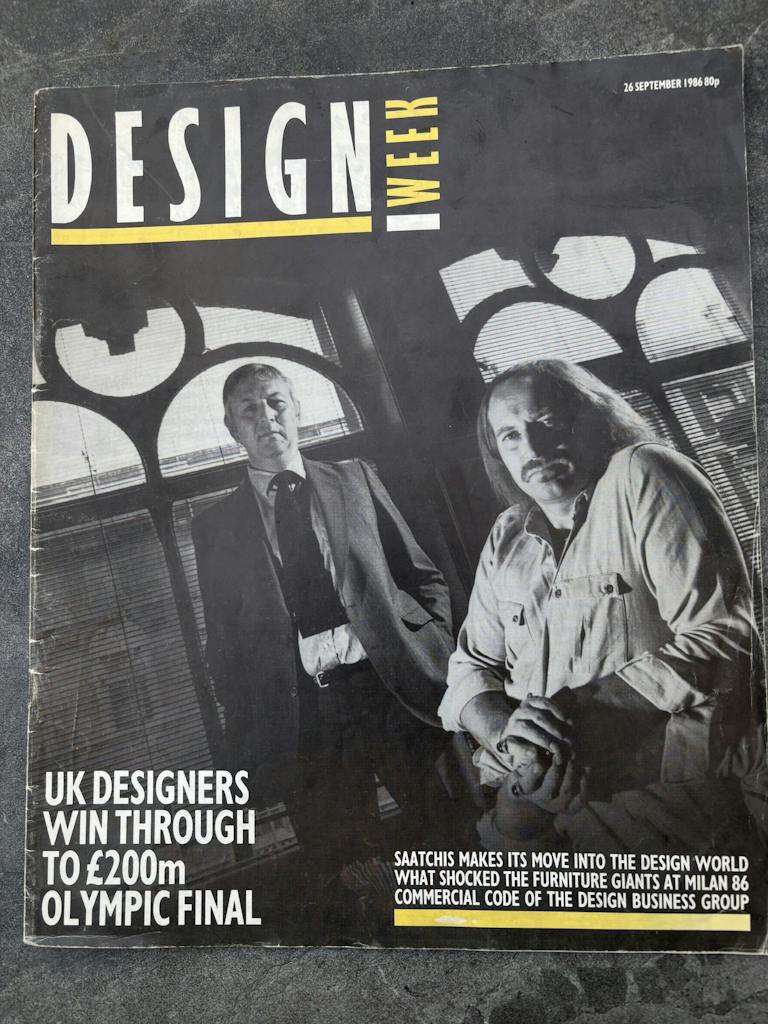

When Jeremy Myerson sat down with me recently to talk about the founding of Design Week, he brought along a remarkably well-preserved piece of history: an original copy of Issue 1, dated 26th September 1986.
The cover story was about two interior designers bidding for the 1988 Seoul Olympics. Tucked beside it was a live report filed direct from the Milan Furniture Fair – included specifically to prove that a weekly design paper could operate in real-time – and a scoop that Saatchi & Saatchi were buying up design firms to set up Saatchi Design.
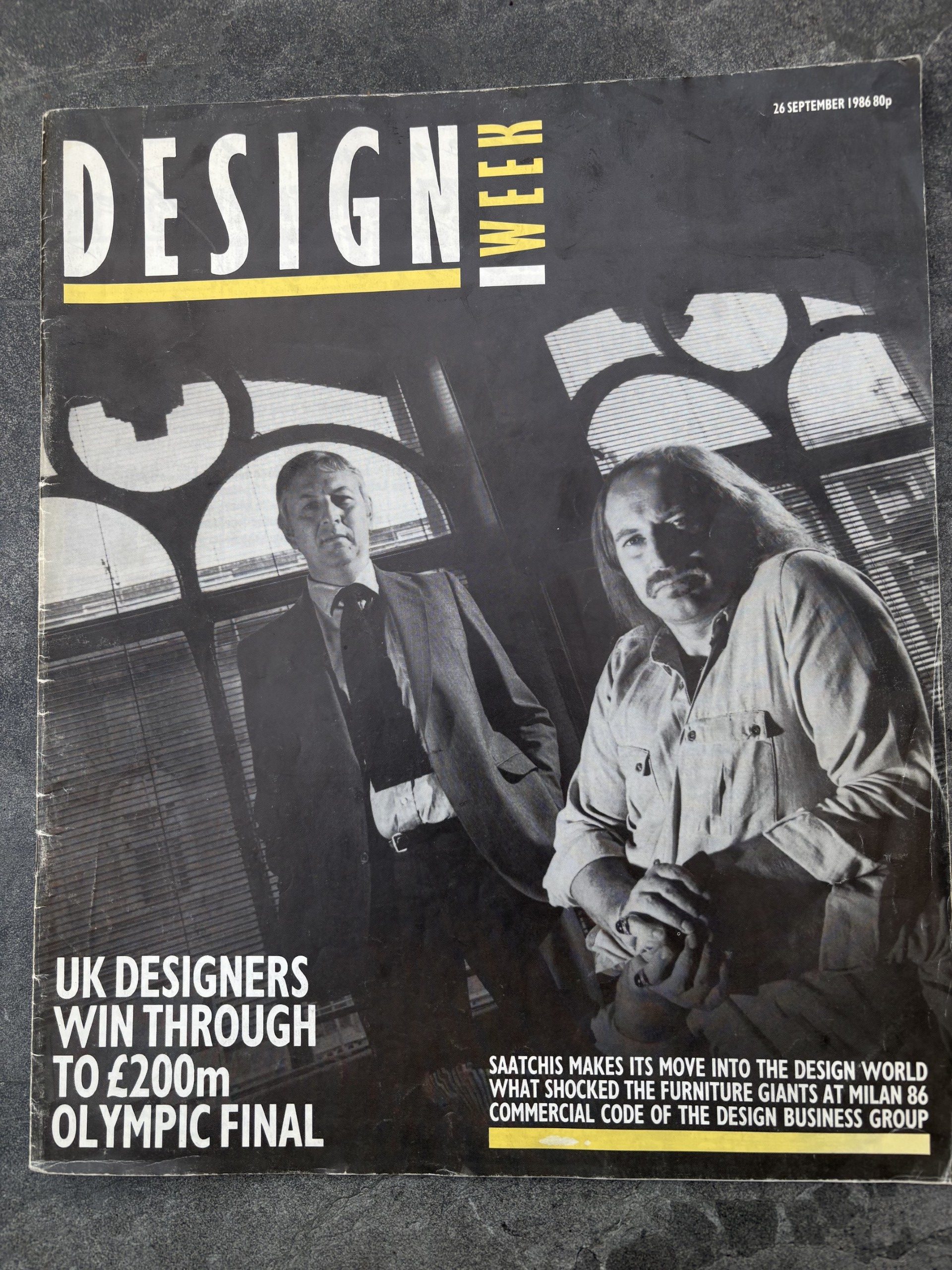
Looking at it today, it feels like a dispatch from a completely different era. Back in 1986, designers were very much the backroom relations of the creative world. Advertisers and marketers got the limelight, while designers sat quietly in the shadows. Design Week was created to challenge that dynamic – to give the UK design industry a confident, fast-moving, weekly business paper that treated design as a commercial powerhouse rather than a polite cultural hobby.
As we prepare to celebrate our 40th anniversary, looking back at how this publication came together reveals a story full of ambition, near-disaster, and a staggering amount of seat-of-the-pants grit.
The dummy issue and the 1965 cup winners
Before you launch a weekly trade paper, you have to convince a publisher that the market actually wants one. In early 1986, while working behind the scenes at Centaur Communications, Jeremy set about building a dummy issue alongside veteran publisher Peter Williams and art director Bob Bateman.
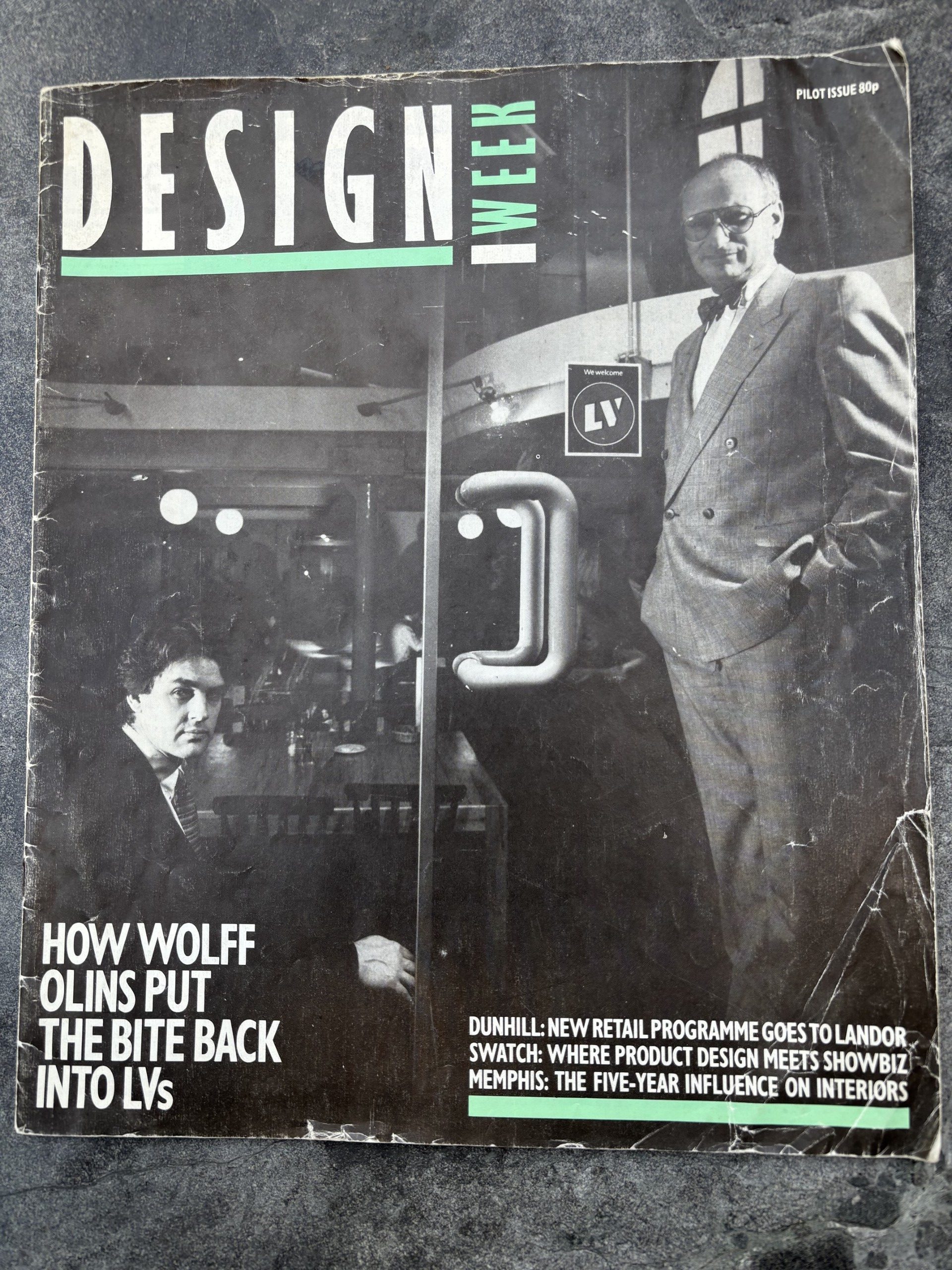
On the mock cover, visual identity pioneer Wally Olins was pictured tongue-in-cheek, designing luncheon vouchers. Inside, the pages looked like a sleek, black-and-white, heroic news publication. But because copy was still scarce and the title was top-secret, Jeremy needed author names for the news stories and opinion pieces.
Being a lifelong Liverpool fan born in Mill Road Maternity Hospital in Everton, Jeremy turned to the only logical source of authoritative pseudonyms: the 1965 FA Cup-winning Liverpool team.
And so, the dummy issue of Design Week went to potential advertisers with erudite design critiques authored by Roger Hunt, Ian Callahan, and Ian St. John.
Years later, a friend of Jeremy’s happened to meet a couple of those former players in a hotel bar in Spain while they were on a golfing holiday. When she revealed that their names had once been co-opted as pioneer design critics to help launch a serious trade magazine, they found the whole thing hilarious.
Wax boards, scalpels, and a motorbike crash
Putting a print weekly to bed on a deadline in 1986 was a physical, high-stress ordeal that sounds almost mythical in today’s digital newsroom.
On Tuesday nights, the editorial team would gather in Hoxton Square – then a rather rough corner of East London, long before the art galleries, creative agencies and coffee shops moved in. They were using phototypesetting and manual wax paste-up. Long columns of text were run through a desktop waxer, laid out onto grid boards, and aligned by hand with scalpels and T-squares.
Once the physical boards were complete, they were locked in a bag and handed to a motorcycle courier. His job? To drive through the night down the M4 motorway to deliver the physical artwork to a printer in South Wales so the magazine could hit newsstands on Thursday morning.
It was a tight, effective operation – until the night the courier came off his bike on the M4. The artwork miraculously survived, but the delay pushed publication from Thursday morning to Friday, giving the production team a stressful day.
Then there was the finality of print itself. Today, if an error slips onto our website, it can be corrected in a matter of seconds. In 1986, a print mistake was etched into paper forever.
Jeremy recalled a major cover feature on the celebrated ceramic design team Queensberry Hunt. He signed off the final proofs with David Queensberry’s name spelled correctly. But late at night at the press, a well-meaning compositor thought he’d spotted a typo and “corrected” the spelling on the press plates to Queensbury. Thousands of copies rolled off the line with Queensberry misspelled on the cover, leaving Jeremy to pick up the phone the next morning and break the news to David Queensberry personally.
“If you believe in design” – and six weeks of panic
When Design Week officially launched, it didn’t slip quietly onto the market. The initial ad campaign aimed at creative agencies carried an explicitly ecclesiastical theme. Print ads pictured copies of Design Week resting on a church pulpit beneath the headline, “If you believe in design” or a stairway heading to heaven headlined with “Where do all good designers go to?”
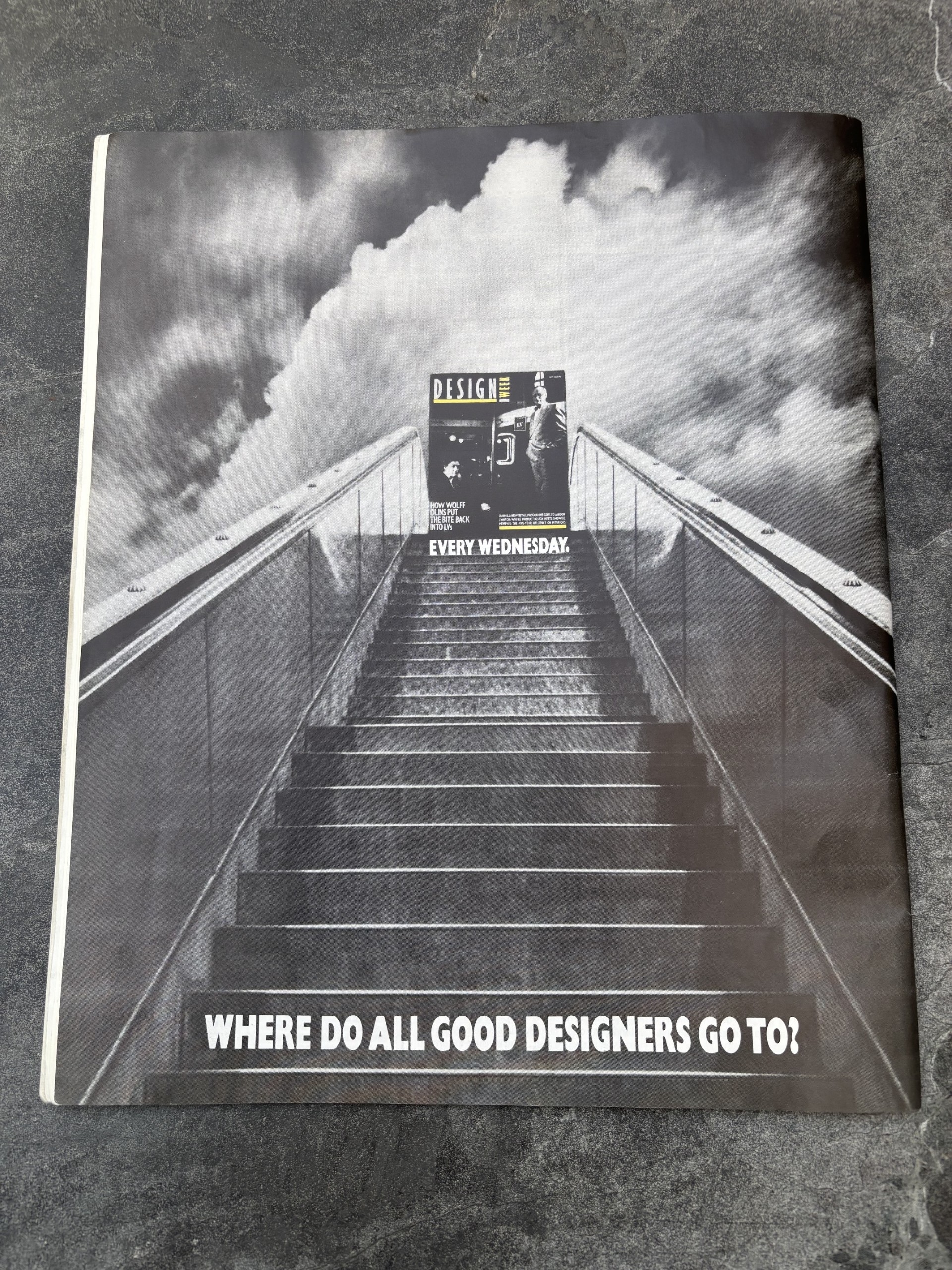
The message was provocative, but clear: design was not just a service job. It was a calling, a vocation, and a conviction.
Readers responded immediately, snapping up charter subscriptions at £10 for 50 issues. But display advertising was painfully slow to follow. Six weeks in, management at Centaur began to panic, calling crisis meetings to question whether the magazine had a future. Jeremy and ad manager Roger Beckett pleaded for time, arguing that agencies simply weren’t used to buying space in a weekly design title yet. Management held its nerve, the commercial tide turned, and advertising began to pour in.
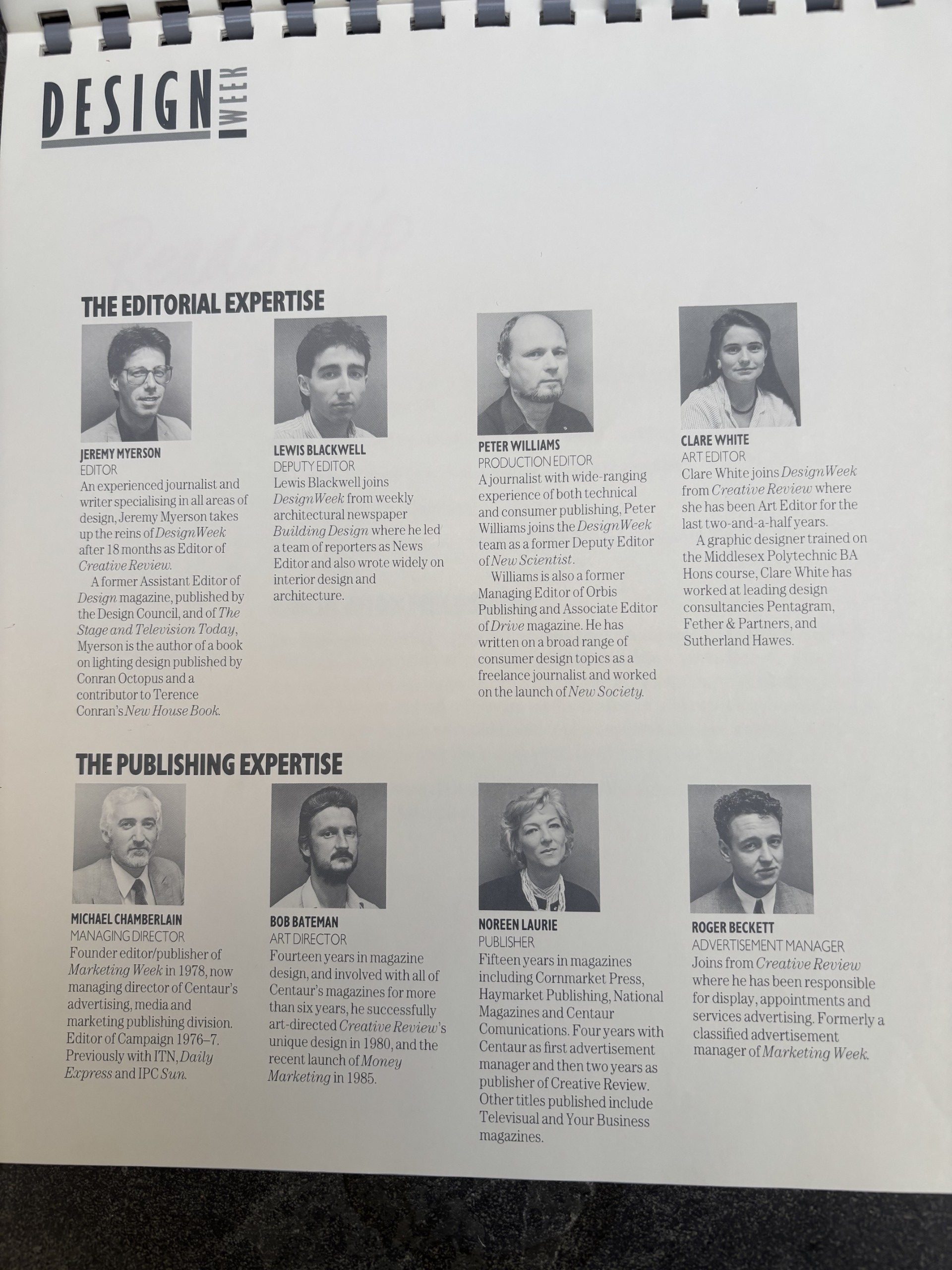
The timing turned out to be spot on. Design Week arrived in September 1986, just weeks before the “Big Bang” deregulation of the City of London. Suddenly, financial institutions were flush with cash and desperate for corporate identity, workspace design, and branding. Concurrently, the Design Business Association launched and the Business Design Centre opened in Islington.
It was the start of an extraordinary boom. Figures like Terence Conran, Rodney Fitch, Michael Peters, Wally Olins, and Michael Wolf became household names. Studio culture was vibrant, social, and fuelled by hospitality. Design Week reporters would visit agencies, talk strategy over lunch, and cover fierce rivalries over major retail accounts. It was competitive, fast-paced, and wildly creative.
From CAD panics to AI interns
Looking back across 40 years, it is easy to see an industry in constant transition. Today’s media landscape is infinitely more complex, fragmented, and fast-moving than the one we covered in 1986.
Yet many of the core industry anxieties remain remarkably similar. In the late 80s, studios were in a moral panic over Computer-Aided Design (CAD) and desktop publishing, worrying that automation would decimate the traditional craft of graphic and product design.
Today, that same anxiety centres on artificial intelligence. But as Jeremy noted during our chat, powerful new tools rarely eliminate human creativity – they usually shift where the value lies. A recent report from the Design Council put it neatly: stop panicking about AI, because it is essentially going to act like the office intern – hoovering up junior, repetitive tasks, while leaving high-level strategy, human empathy, and creative problem-solving to experienced designers.
It brings to mind a definition that the legendary Pentagram partner Alan Fletcher once shared with Jeremy:
“Design is a mental utensil. It isn’t a chair or a typeface or a vase. It’s a way of thinking and a way of acting.”
Tools change, delivery mechanisms evolve, and workflows adapt. But that fundamental way of thinking endures.
The Merseyside connection
There is also a quiet, unexpected thread running through the 40-year history of Design Week: a persistent Merseyside connection.
Jeremy grew up in Liverpool before heading south to forge his career in journalism. Linda Ralph Knight – the formidable editor who took over from Jeremy and built the title and the Design Week Awards over a 20-year tenure – hailed from Formby. And today, we’ve brought Design Week’s headquarters to Liverpool, operating in the shadow of the city’s two cathedrals.
Taking an established title out of London and running it as an independent digital publication comes with its own set of seat-of-the-pants challenges – not entirely unlike the ones Jeremy faced back in 1986. The production tools are different whilst the fundamental mission of championing design remains.
Forty years on from that first issue with its Seoul Olympics cover story, Design Week is still here. The landscape is tougher and more contested than ever, but the core belief that launched the title on a church pulpit in 1986 remains unchanged: design matters, human ingenuity counts, and it is always worth making a noise about.
Become a Design Week member for £4/month or £40/year
Already a member? Sign in.



 Estudio EA