



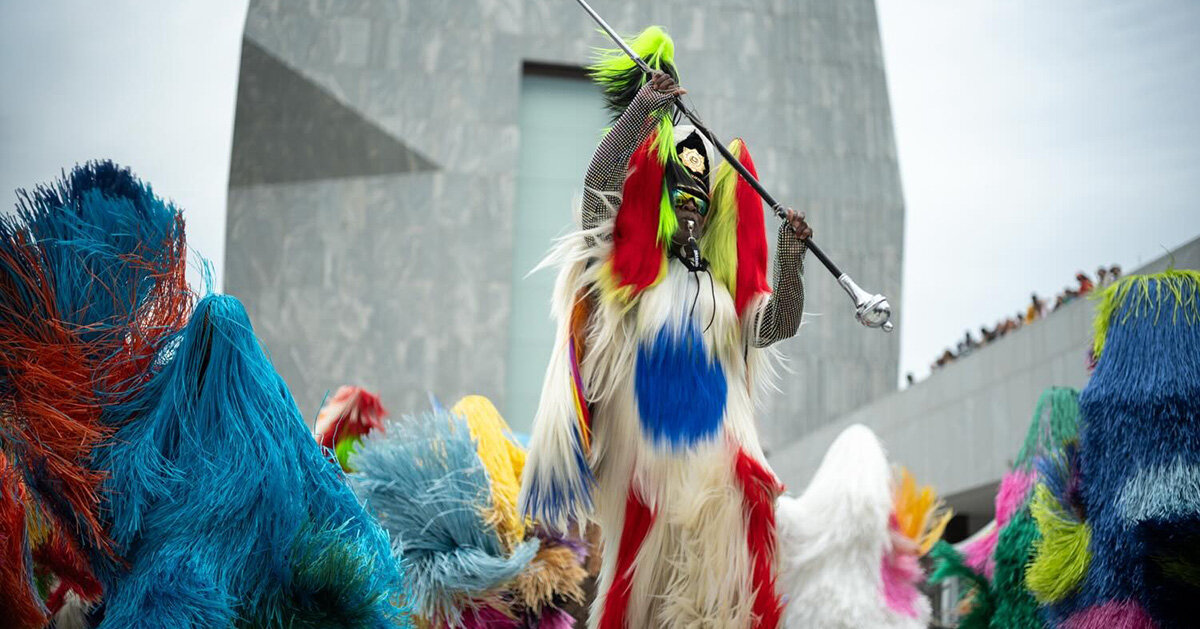

nick cave’s soundsuits: when the body becomes the stage
Imagine a sculpture that does not sit on a plinth, but moves through a train station, a street, or a crowded hall. Its surface rattles with every step, its scale alters the silhouette of the person inside, and its elaborate construction makes the wearer almost impossible to identify. This is the basic proposition of Nick Cave’s Soundsuits: the garment becomes an environment, and the body becomes its architecture.
Cave made the first Soundsuit in Chicago in 1992, following the Rodney King beating and the acquittal of the police officers involved. The event left him thinking about racial profiling, vulnerability, and what it meant to be perceived as a Black man in public. While walking through Grant Park, he found a twig and began gathering hundreds of them, eventually assembling them into a full-body sculpture.‘The moment I put it on and started to move, it made sound,’ Cave recalled. ‘Sound at that moment was my call for protest. It was a way of being heard.’
The garment functioned as what Cave describes as an ‘emotional shield’, a form of armor that concealed the wearer’s race, gender, class, and other visible markers of identity. But the discovery of the sound it made also shifted the work beyond protection. The suit could move, perform, attract attention, and occupy space.
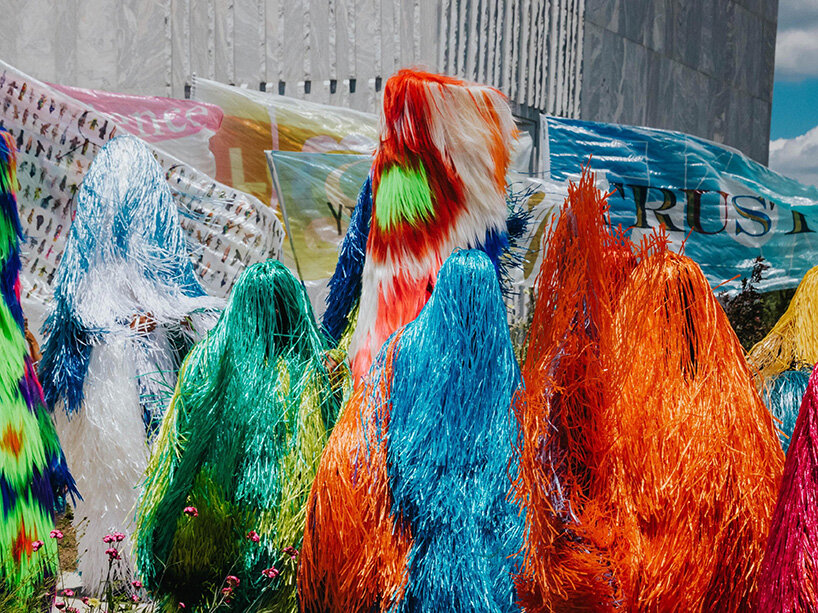
image by Dayson Roa
A second skin that changes the body
Soundsuits are wearable sculptures that completely envelop the human figure. They can incorporate fabric, wire, raffia, feathers, beads, buttons, sequins, plastic toys, ceramic objects, synthetic fibers, rugs, quilts, and other found materials. Their surfaces are often densely assembled, turning ordinary objects into highly elaborate bodies.
The materials have changed considerably since the original twig suit, but the principle of accumulation remains. Cave gathers discarded and everyday objects and reorganizes them into forms that are difficult to classify. A suit made from hundreds of small plastic figures, for example, can become something closer to a moving landscape than a conventional garment.
Cave has described the suit as a ‘second skin’ that hides the identity of the person inside. ‘When I was inside a suit, you couldn’t tell if I was a woman or man… I was no longer Nick. I was a shaman of sorts,’ he has said.
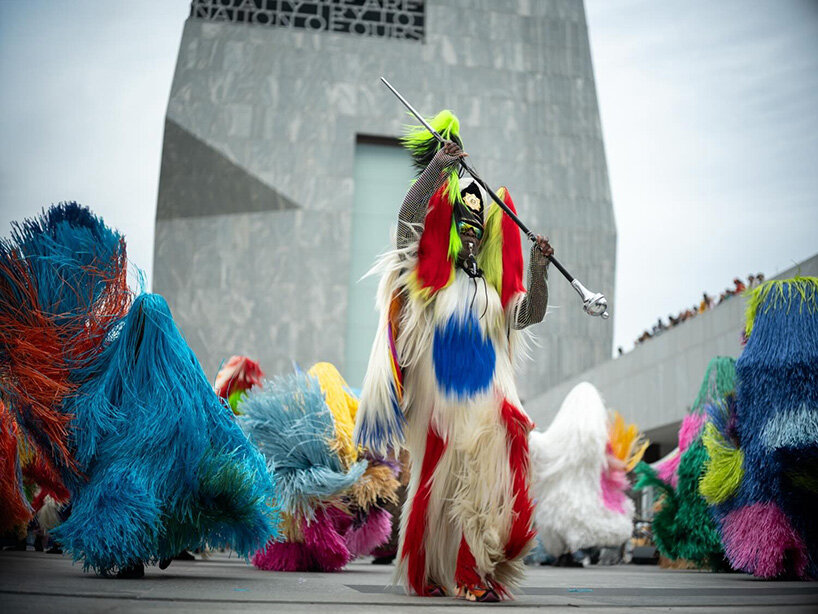
Soundsuits performance during the opening festivities of The Obama Presidential Center | image by Mitch Buss
When the body becomes architecture
Through the Soundsuit, Cave builds the stage onto the performer. The suit expands the body beyond its ordinary proportions. Strands of raffia extend into the surrounding air; beads and other elements move independently; rigid frames establish new silhouettes. When the wearer walks or dances, the sculpture alters the space around them, establishing a boundary between them and the outside world while simultaneously projecting outward into it.
Without a recognizable face or body, the viewer has fewer visual cues through which to categorize the person inside. Cave has explained that the suits ‘hide gender, race, class’ and force audiences to look at the work without judgment.
The anonymity is not neutral, however. It originates in a specific experience of racial vulnerability. Cave’s work does not erase that history so much as transform it into a question: what happens when the visual information through
which people are routinely judged disappears?
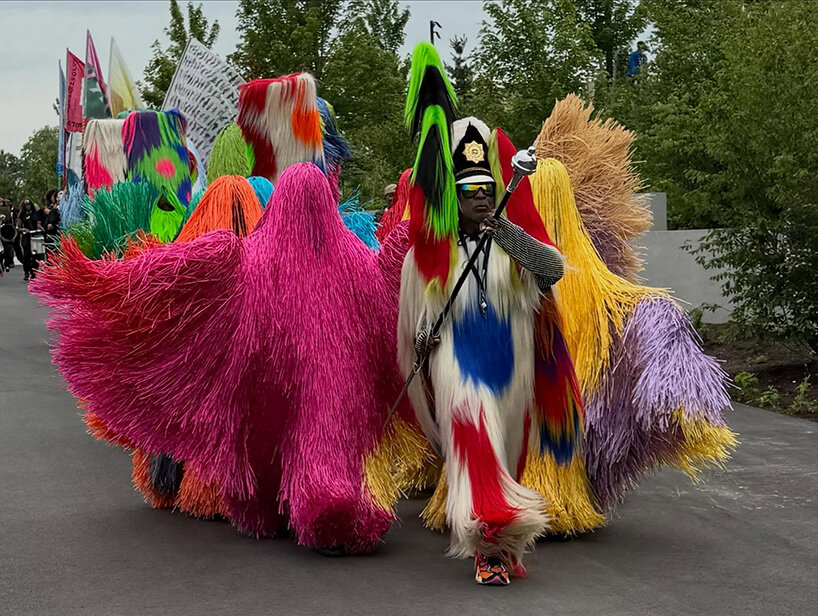
a form of armor that conceals the wearer’s race, gender, class, and other visible markers of identity | image by Elizabeth Corr
The stage moves into the crowd
For Heard NY in 2013, Cave worked with 30 dancers in horse-like Soundsuits who moved through Grand Central Terminal accompanied by live music. The performance interrupted the everyday routes of commuters. A building designed for circulation became, temporarily, a theater.
The same principle appears in Heard presented in Detroit, where a procession of horse-shaped Soundsuits and local dancers moved along Detroit’s riverfront, and in Up Right Chicago, presented during the Chicago Architecture Biennial. There, Soundsuit-clad performers were brought together with reflective ‘Stage Buoy’ sculptures designed by Studio Gang.
In these works, the distinction between performer and spectator becomes unstable. People stop, photograph, watch, and sometimes participate. The architecture does not disappear, but its function changes. A terminal becomes a parade route; a park becomes a performance ground; a monumental hall becomes a place for collective dancing.
Cave’s The Let Go, presented at the Park Avenue Armory in 2018, pushed this further. The large drill hall became a space for performance, music, dancing, and participation, with Soundsuit-clad dancers moving through crowds alongside live musicians, DJs, and singers.
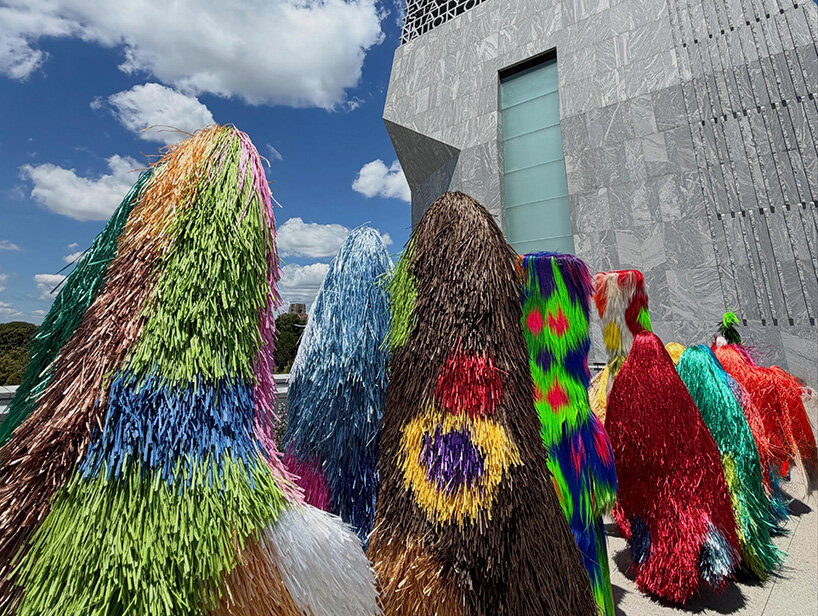
20 Soundsuits were part of the performance | image by Elizabeth Corr
Sound turns sculpture into action
The first suit produced sound as Cave moved, and subsequent works have continued to incorporate materials capable of rattling, scraping, rustling, or colliding. Beads, shells, bells, buttons, and other loose components turn movement into percussion. This means that the suits cannot be understood entirely through photographs. Their sound and movement are structural parts of the work.
A static Soundsuit may initially read as an elaborate sculptural object. Once worn, its meaning changes. Walking activates the materials. Dancing amplifies them. The performer creates a sonic envelope that moves through the surrounding space.
The physical complexity of the Soundsuits also comes from their labor. Beading, stitching, weaving, binding, layering, and assembly are central to the practice. Cave’s use of found and discarded materials connects the works to a broader history of making through reuse and improvisation, while his interest in African ceremonial dress and African-American craft traditions informs the visual language.





 Estudio EA