

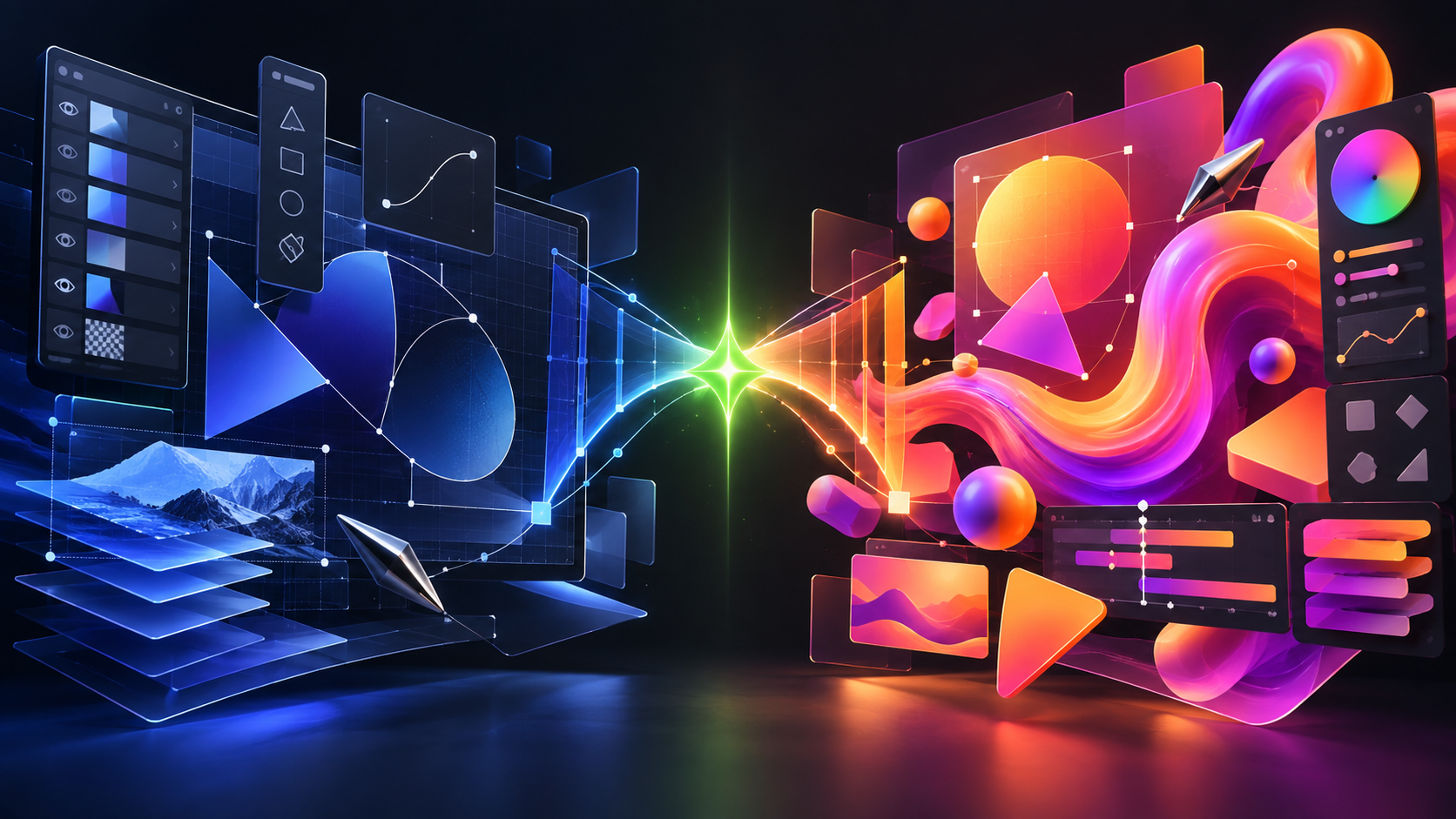

Canva has connected Affinity, Cavalry, Flourish, and Leonardo into a new pro-creative ecosystem—and it is keeping the core Affinity and Cavalry apps free. Adobe is not about to vanish in a puff of overpriced subscription smoke, but this is the clearest signal yet that Canva wants the professionals too.
For years, Canva lived in a very particular corner of the creative world: handy, fast, template-heavy, and just slightly likely to make a senior designer mutter, “I’ll fix it in Illustrator.”
Now it is making a much bigger play.
Canva ProSuite connects Affinity, Cavalry, Flourish, and Leonardo. The stated pitch is an end-to-end workflow: create in Affinity, animate in Cavalry, make data visualisations in Flourish, generate variations in Leonardo, then share and scale work in Canva.
That is a genuinely good idea.
The part Adobe should notice
Affinity is now a single app for professional vector work, photo editing, and page layout. Its latest update adds a Blend Tool and in-app scripting, alongside native IDML import, expanded RAW-photo tools, and Canva’s AI-assisted Scene Decomposition feature.
The key practical detail is file compatibility. Affinity says it can import PSD, AI, IDML, and DWG files while preserving layers and structure—exactly the sort of thing that decides whether a designer can even consider changing tools.
Meanwhile, Affinity is free for individuals. Cavalry is also free for individuals, with professional 2D-animation features and no paid tier required for normal individual use.
Free is doing a lot of work in that sentence.
Professional designers do not switch tools because a company puts “AI” on a keynote slide 47 times. They switch when the alternative handles their files, fits their workflow, does not feel like a toy, and stops charging rent for the privilege. Affinity is moving much closer to that threshold.
Adobe still has the industry gravity, decades of muscle memory, and the ecosystem that makes “please send the PSD” a sentence nobody questions. But Canva is now offering a credible counterargument: design in a professional tool, animate it, hand selected controls to colleagues inside Canva, and keep the master file from being turned into a branded crime scene.
Canva wants the last mile too
The most interesting detail is the handoff.
Canva says motion designers will soon be able to choose which elements of a Cavalry animation—such as text or colour—can be edited directly inside Canva, while the core scene stays locked. That means a marketing team could turn “Summer sale” into “Autumn sale” without emailing a designer, opening After Effects, or accidentally changing every font to something that looks like it belongs on a cupcake shop.
It is the sensible version of AI-era creative software: not “press a button and replace the designer,” but “stop making skilled people spend Tuesday afternoon resizing 83 social posts.”
Canva’s own language about craft is, naturally, very Canva. But the product strategy is more convincing than the slogan. AI makes basic output cheap. That makes taste, control, and brand consistency more valuable—not less.
One caveat: Canva AI features inside Affinity require a Canva premium plan. The free offer applies to the core Affinity and Cavalry apps, not every AI capability around them.
The old assumption was that Canva was where non-designers went to make things look designed. Its new goal is more ambitious: become the place where professional work starts, travels through a company, and survives the trip.
Adobe should not panic. But it should probably stop laughing.


 Estudio EA