




Summary:
How people react to being told that AI helped create a piece of content varies with audience, context, the nature and degree of AI use.
In 2024, the EU adopted a landmark AI law, which requires companies to disclose AI-generated content in particular cases; the transparency obligations started in August 2026.
This change in disclosure policy surfaces a practical concern: telling users about AI use may alter how they judge the content’s trustworthiness, authenticity, or quality, and ultimately may affect brand relationships. Research shows that reactions to AI disclosures are not uniform: they depend on the audience and on the type of content that carries the disclosure, among other factors.
This article summarizes the research and presents 5 factors to weigh when you’re considering whether to disclose AI use for generating text content.
What Is AI Disclosure?
An AI disclosure is a human-readable statement that explains how AI was involved in creating the content.
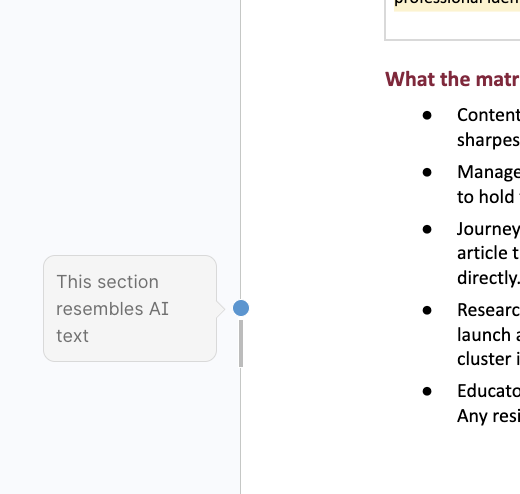
AI disclosures can vary in form or prominence. On social media, for example, they might appear as pills or icons next to the caption. Longer pieces of text might include the disclosure at the bottom of the page in a card or as inline text.
Proactive vs. Third-Party Disclosures
Disclosures added by the AI user are proactive disclosures, since the creator is sharing the information. Third-party disclosures are made by the platform where the content is hosted or by another user.

Watermarks vs. AI Disclosures
AI disclosures shouldn’t be confused with AI-provenance marks or watermarks, such as the statistical watermark Anthropic released for its newer Claude models. These marks are machine-readable and can’t be detected with a human eye or screen reader alone. AI disclosures, on the other hand, must be easily accessible to human sight or to a screen reader, without additional readers or tools.
When AI Disclosure Has No Consistent Effect
Research does not show that AI disclosure consistently produces a negative reaction. Across the experiments and reports we reviewed for this article, there wasn’t one consistent audience reaction to AI disclosure. Its effects varied across studies and contexts: in some cases, AI disclosure made people rate the content as less trustworthy, authentic, or high-quality; in others, it had no measurable effect.
Lorena Licenji and Julian Hoxha reviewed 47 studies of how readers react to AI authorship and disclosure in news. They found no consistent reaction to AI involvement in news production: across the full set of studies, the results varied depending on the type of news, the perceived credibility of the publisher, and the audience characteristics. Only 10 studies in their review explicitly told readers that AI had been involved in creating the content, isolated the effect of the disclosure itself; these studies also found no consistent effect on trust or credibility penalty.
Most of the research we report in this article used attitudinal metrics to assess the effect of disclosure: study participants had to rate trustworthiness, authenticity, or quality after seeing an AI disclosure. One exception was a study by Zoe Purcell and colleagues, who measured trust both attitudinally and behaviorally. In their experiment, strangers played a trust game with real monetary consequences: after receiving a message from another player, participants decided how much money to send to that person. Some messages were labeled as AI-assisted. The AI disclosure did not reduce either how much money message recipients sent or their rating of the other person’s trustworthiness.
In this type of transactional exchange between strangers, AI disclosure appeared to carry no penalty, whether measured as a rating or through participants’ actual behavior
The Role and Extent of AI Involvement Matters
Several studies suggest that audiences’ reactions depend on knowing not only whether the AI was used, but also on knowing what role it played and how much AI contributed to the content.
For example, in Zhuoyan Li and team’s experiment, telling readers that AI had generated the content lowered how they rated the quality of both argumentative essays and creative stories. In contrast, telling them that AI had only edited the text had a narrower effect: ratings fell for creative stories but not for essays.
Hiroki Nakano and team found a similar pattern. In their study, readers rated a text’s author, then they were told that a specified percentage of the text had been generated or edited by AI and asked to rate the author again. The readers’ ratings decreased as the disclosed percentage of AI involvement increased.
Additionally, some of the studies reviewed by Licenji and Hoxha found that readers had more negative reactions when the disclosure suggested that AI had produced the content autonomously, without clear human involvement and accountability.
Stronger Negative Reactions When Human Contribution Matters
Several studies suggest that, when users expect human judgment, sincerity, or connection in their communications, they’re more likely to rate the content more negatively after an AI disclosure.
AI disclosure can make content or its creator seem less authentic. In Jasper David Brüns and Martin Meißner’s pre-study, participants could not reliably tell AI-generated fashion images from human-made ones. Yet, in the full study, when an AI-generated image was embedded in a brand’s social media posts and disclosed as AI-generated, participants rated brand authenticity, post credibility, and brand attitudes lower.
Siavosh Sahebi and team found a similar pattern in ratings of workplace emails and social media posts: emails and social media posts were rated as less trustworthy and less authentic when AI use was disclosed, and people were less likely to use the information in them when AI use was disclosed.
The same effects appeared in some studies examining creative or interpersonal writing. (Interpersonal writing refers to communications such as thank-you notes and personal letters meant to maintain or build relationships, rather than to convey information.) In Nakano’s and colleagues’ study, ratings of the author’s trustworthiness, caring, and likability fell most when AI helped with interpersonal text. Readers were more tolerant of AI use in argumentative, creative, and exploratory writing.
In Li and team’s experiment mentioned above, disclosing that AI had edited creative stories lowered readers’ quality ratings for creative stories, but not for argumentative essays.
All these findings suggest that readers will be more likely to penalize AI use when they believe AI has replaced a meaningful human contribution, such as creativity, sincerity, or personal judgment.
Audience Attitudes Matter
In a pooled analysis of 12 of their 13 experiments, Oliver Schilke and Martin Reimann found that the trust penalty from AI disclosure was smaller among people with more-favorable attitudes toward technology and among those who believed AI was accurate, although it did not disappear entirely.
Readers’ own writing confidence could also affect their reactions. In Li and colleagues’ study, readers who rated themselves as more confident writers tended to lower their quality ratings more after AI use was disclosed, while lower-confidence writers were generally less negative. Familiarity with AI also shaped readers’ reactions, but not consistently: being more familiar with ChatGPT did sometimes (but not always) make them more accepting of disclosed AI use.
Together, these findings suggest that reactions to the same disclosure depend partly on the audience’s existing attitudes towards technology or AI, familiarity with it, and confidence in their writing skills.
The Disclosure Paradox
The findings so far describe how readers react once AI use is disclosed. But do they even want disclosure? The answer reveals a contradiction that Siavosh Sahebi, Paul Formosa, and Sarah Bankins call the “disclosure paradox.”
The disclosure paradox refers to readers saying they want AI use disclosed, yet reacting negatively to content that carries that disclosure.
In Sahebi’s and colleagues’ study, participants rated AI-attributed text as less trustworthy, less authentic, and less useful, even though they said that disclosing AI use was important.
Jingchao Fang, Victoria Xiaohan Wen, and Mina Lee found a related tension when they asked people to judge writing scenarios as readers or as writers. Writers were far less likely than readers to consider an AI disclosure necessary. People want to be told about others’ use of AI more than they want to disclose their own.
Together, these findings reinforce the disclosure dilemma for content creators. Readers claim they want to see disclosures, yetdisclosures, yet penalize writers for meeting those expectations. However, that does not mean you should conceal your use of AI. Across several experiments, Oliver Schilke and Martin Reimann found that people trusted a person or company that disclosed its use of AI less than one that said nothing about it. Their final experiment revealed they trusted one whose AI use was exposed by a third party least of all. If your use of AI could later be exposed, disclosing it proactively may be the safer option.
Guidance for handling AI disclosures cannot be as simple as “AI disclosure erodes trust” or “don’t disclose.” The effect depends on the context.
PACED: A Framework for Considering Disclosures
No single rule determines whether you should disclose. When disclosure isn’t mandated, work through the five PACED factors — policy, audience, context, expectations, and degree of AI contribution — as a set of questions to decide whether to disclose your AI use.
Policy: Is Disclosure Mandated by Law, Policy, or Platform?
Policy refers to the rules of the country, organization, or platform where people may see your content.
For example, if you’re writing content that falls under the specific cases in the EU AI Act, you legally must disclose your AI use.
If you create for a country or organization that doesn’t have an AI disclosure policy, consider the rules of your platform. Some platforms may automatically apply an AI label based on technical signs. Since third-party AI disclosure triggered the strongest negative reactions in the studies we reviewed, consider proactively disclosing your AI use before the platform does it for you.
Audience: How Is Your Audience Likely to View AI Use?
Audience includes all the preexisting attitudes your audience has towards technology, AI, and the domain for which you’re creating.
Based on the research summarized here, people with more favorable attitudes toward technology or AI may react less negatively to disclosures. Audiences confident in their own writing may react more negatively to disclosed AI assistance in their evaluations of writing quality.
Context: How Much Does Human Contribution Matter?
Context refers to the type of interaction for which the content was created. Disclosures on communication with an emphasis on human experiences (such as fiction or interpersonal writing) might receive greater scrutiny.
Consider how much the value of what you’re communicating depends on qualities that people normally associate with a human author — sincerity, creativity, or personal connection. Routine, transactional, or purely informational messages (like appointment reminders) are not meant to communicate human emotion and authenticity, so negative reactions to AI disclosure are likely to be mild.
Expectations: Is AI Disclosure Expected by Your Users?
Expectations refer to whether your readers assume they will be told when AI was involved. Research shows that readers and writers often disagree on this point. Your own sense of whether disclosure is needed might not match your users’ expectations (another instance where the “you are not the user” principle applies).
Ask yourself whether your readers would feel misled if they later learned that AI was involved — for example, because your organization or your field has established a norm of disclosing AI use.
Even though AI disclosure may make readers view the content less favorably, it is still the safer choice: being exposed by a third-party risks triggering a stronger negative reaction than disclosing it proactively.
Degree of AI Use: How Much Did AI Contribute to the Content?
Finally, consider how much AI contributed to the content. Using AI to clean up a few paragraphs in an article is different than using it to generate a whole article or a framework.
The more central the AI’s contribution, the stronger the reason to consider disclosure, because without it, readers may incorrectly attribute work or judgment to the human author. On the other hand, research also suggests that readers may react more negatively when substantial AI involvement is disclosed. This creates a tradeoff between transparency and the potential reputational impact of disclosure.
Conclusion
As AI-disclosure requirements become more common, organizations that use AI for generating content will have to weigh its efficiency benefits against the risk that disclosure lowers users’ perceptions of trust and authenticity. Research offers no universal rule, but the PACED framework turns the decision into questions you can answer for your own content, audience, and context.
References
Jasper David Brüns and Martin Meißner. 2024. Do you create your content yourself? Using generative artificial intelligence for social media content creation diminishes perceived brand authenticity. Journal of Retailing and Consumer Services 79 (July 2024), 103790. https://doi.org/10.1016/j.jretconser.2024.103790
Jingchao Fang, Victoria Xiaohan Wen, and Mina Lee. 2026. What Influences Readers’ and Writers’ Perceived Necessity of AI Disclosure? In Proceedings of the 2026 ACM Conference on Fairness, Accountability, and Transparency (FAccT ’26). Association for Computing Machinery, New York, NY, USA, 894–920. https://doi.org/10.1145/3805689.3806724
Zhuoyan Li, Chen Liang, Jing Peng, and Ming Yin. 2024. How Does the Disclosure of AI Assistance Affect the Perceptions of Writing? In Proceedings of the 2024 Conference on Empirical Methods in Natural Language Processing. Association for Computational Linguistics, Miami, Florida, USA, 4849–4868. https://doi.org/10.18653/v1/2024.emnlp-main.279
Lorena Licenji and Julian Hoxha. 2026. When news is “written by artificial intelligence”: a systematic review of provenance and disclosure cues in journalism and their effects on credibility and trust. Frontiers in Artificial Intelligence 9 (May 2026), 1815243. https://doi.org/10.3389/frai.2026.1815243
Hiroki Nakano, Jo Takezawa, Fabrice Matulic, Chi-Lan Yang, and Koji Yatani. 2026. Understanding Reader Perception Shifts upon Disclosure of AI Authorship. In Proceedings of the 31st International Conference on Intelligent User Interfaces (IUI ’26). Association for Computing Machinery, New York, NY, USA, 16 pages. https://doi.org/10.1145/3742413.3789076
Zoe A. Purcell, Maurice Jakesch, Mengchen Dong, Anne-Marie Nussberger, and Nils Köbis. 2025. Writing with AI boosts trust-building efficiency. iScience 28, 12 (December 2025), 114092. https://doi.org/10.1016/j.isci.2025.114092
Siavosh Sahebi, Paul Formosa, and Sarah Bankins. 2026. The AI penalty and disclosure paradox: Trust, authenticity and knowledge uptake in AI-mediated communication. Computers in Human Behavior: Artificial Humans 8 (May 2026), 100304. https://doi.org/10.1016/j.chbah.2026.100304
Oliver Schilke and Martin Reimann. 2025. The transparency dilemma: How AI disclosure erodes trust. Organizational Behavior and Human Decision Processes 188 (May 2025), 104405. https://doi.org/10.1016/j.obhdp.2025.104405





 Estudio EA