



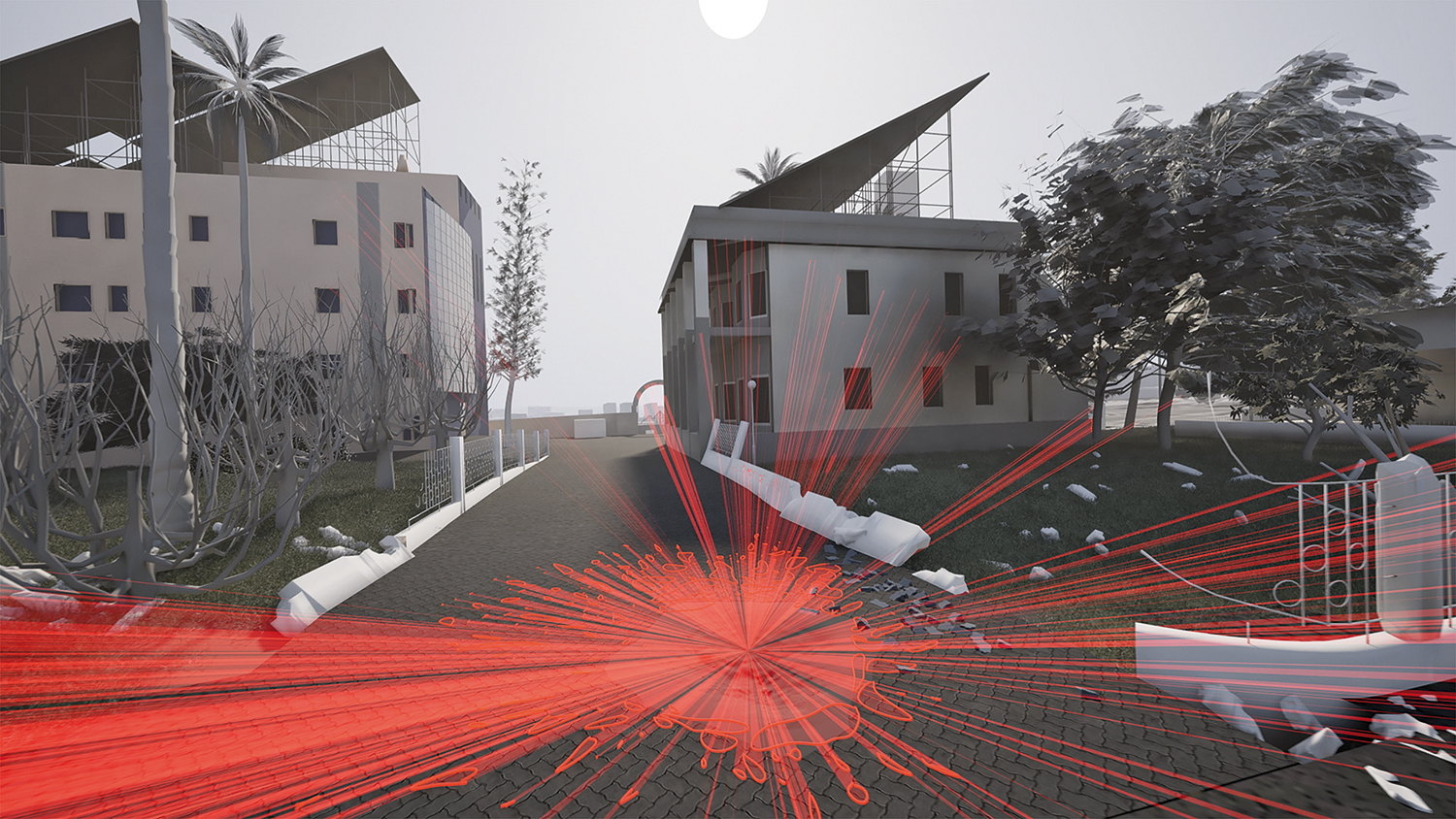

Increasingly, conflict-related or counter-colonial projects take place necessarily at a distance, and there is a trend towards employing techniques of mapping and use of open-source, as in the work of Bouchra Khalili or investigative collective RAKE. The work of former Royal Marine Giles Price on the reconstruction of Iraqi city Mosul offers a unique perspective shaped by a first-hand understanding of military seeing and a collaboration.
Price was just 17 years old when he worked on operations in northern Iraq in 1991 to halt the advance of the Iraqi army towards the displaced Kurdish population, who US special forces and UK allies were charged with protecting. Exposure to the same chemical weapons deployed by Saddam Hussein against the Kurds resulted in medical discharge for Price, followed by 14 years of major surgeries, with life-altering consequences. As he pursued his pre-military passion for photography, he mostly avoided conflict work, but in 2017 he was commissioned by The New York Times Magazine to document wrongly-targeted coalition strikes in Mosul, which caused a high number of civilian deaths. Moreover, this military action was being misreported in the US and UK press as the most accurate air campaign in history.
Price knew he required the aerial view. “I wanted to mirror the surveilling and targeting point of view, but with the hi-res and clarity to see the destruction caused by it,” he says. “At ground level, the rubble was comprised of homes and schools.” In this first visit, unable to take a drone into Iraq, he achieved his desired vision by mounting his camera on a 12-metre telescope carbon fibre pole, triggered with a wi-fi remote.
Drone use has become somewhat ubiquitous within popular as well as critical photography, in tandem with this kit’s commercial availability. Price has been using Chinese-made consumer drones since 2014, the same drones used in Donbas, Ukraine, after the Russian invasion. “Isis in 2016 were the first to weaponise their use by easily modifying them to drop bombs, which led to their widespread use in the battle of Mosul,” he notes. Price was able to rent one from an Iraqi army officer, but geolocation blocks were in place. Unable to use the standard flying software, he found a workaround in photogrammetry apps, sowing the seeds of a new way of working as he did so. Offered “multiple data assets in 2D, 3D and moving image” for the NYT commission, a photogrammetry animation featured in its online edition.
Price’s work Phantom Pro grew out of a relationship with an Iraqi videographer, Ayar Rasool, who purchased the drone from the army officer. Over WhatsApp, Price trained Rasool to fly photogrammetry apps. His ongoing collaboration with Rasool is documented via their messaging, sharing an easy intimacy across time and space; another mode of bringing the human voice into the creation of images. Particularly interested in the al-Nuri mosque, Price paid Rasool to make a photogrammetry set of the iconic symbol of Isis dominance. The ancient mosque was the site of the infamous 2014 sermon in which Isis leader Abu Bakr al-Baghdadi claimed a new caliphate, and which his militant group blew up in a final act of vengeance before Mosul fell.
Fast forward to an image of that site now. Aesthetically, it hovers somewhere between a graphic and a painting. The matt grey sky conceals any trace of the threat it once held. A further block of featureless matt grey obscures a patch of foreground. Could it screen a body, killed in the blast? In fact there were no direct fatalities as a result of the Isis bombing, but thousands were killed in the battle for Mosul. Amnesty International reported as many as 10,000 civilians were killed in the nine months of the battle, calling for the Iraqi state and US coalition forces to accept responsibility for the deaths. The mosque’s turquoise dome in this image is its defining feature, yet the surrounding rubble has subsumed al-Hadba, its singular, leaning minaret, built in 1172. Attendant trees take on a spectral quality, appearing to have been burnt alive, as though signifiers of ecocide.
 Estudio EA