


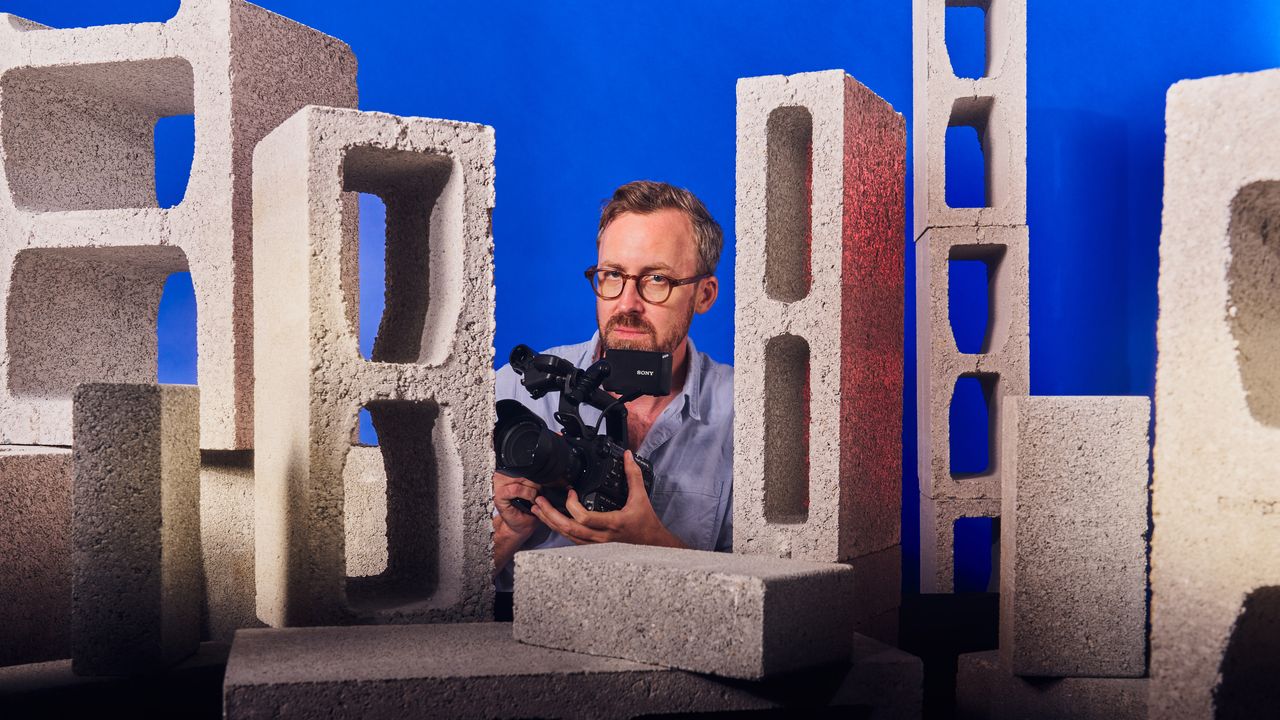

Filmmaker John Wilson and I are seated in a kitchen on the 35th floor of One World Trade Center, the tallest building in New York. Like most of Manhattan, this tower worships at the altar of concrete, which makes up its core, foundation, and floor slabs. In this structure alone, there’s enough of it to pave more than 4,000 New York City blocks.
Concrete—the second-most-used material on earth, just behind water—is also what brought Wilson from his home in Ridgewood, Queens to Lower Manhattan to talk to me today. On September 18, his first feature-length film, The History of Concrete, will be released in theaters (including Low Cinema, the 40-seat venue he recently rehabilitated with a partner.)

Wilson is still figuring out how to describe The History of Concrete—he calls it “a million things at once.” Running an hour and 40 minutes, it’s ostensibly what its title suggests: a documentary about concrete, the substance that makes up most of the world’s towers, sidewalks, streets, and houses. But as in his Emmy-nominated HBO series How to With John Wilson, that investigation is merely an entry point to a more complex story of how the built world goes up and what takes it down. It’s also a meditation on impermanence, and a portrait of the pains and triumphs of making art in capitalism. Above all, Wilson brings us a plea to think more deliberately about the urban environment—to imagine the possibility of a thousand-year city, rather than settling for the “50-year” version he believes we’re living in now.
As viewers, our journey through all of this starts in Wilson’s own home in Ridgewood, where a cracked foundation brings stormwater gurgling up from the depths. The concrete that has kept his house from sinking into the earth until now is in disrepair; Wilson attempts to patch it himself, leaving behind a craggy keloid on the patio. “Most people just hire a contractor,” he tells me, “but I got a bunch of books and wanted to understand concrete on a more molecular level, to figure out what my house is even made of, and whether or not repairing it now is going to save me a headache in the future.” He embarks on a global journey to trace some of the earliest examples of concrete, still standing in Italy nearly 2,000 years after the decline of the Roman empire. If this stuff has managed to stick around, why then is Wilson’s own home falling apart? Better yet: Why does everything else seem to be falling apart, too?