



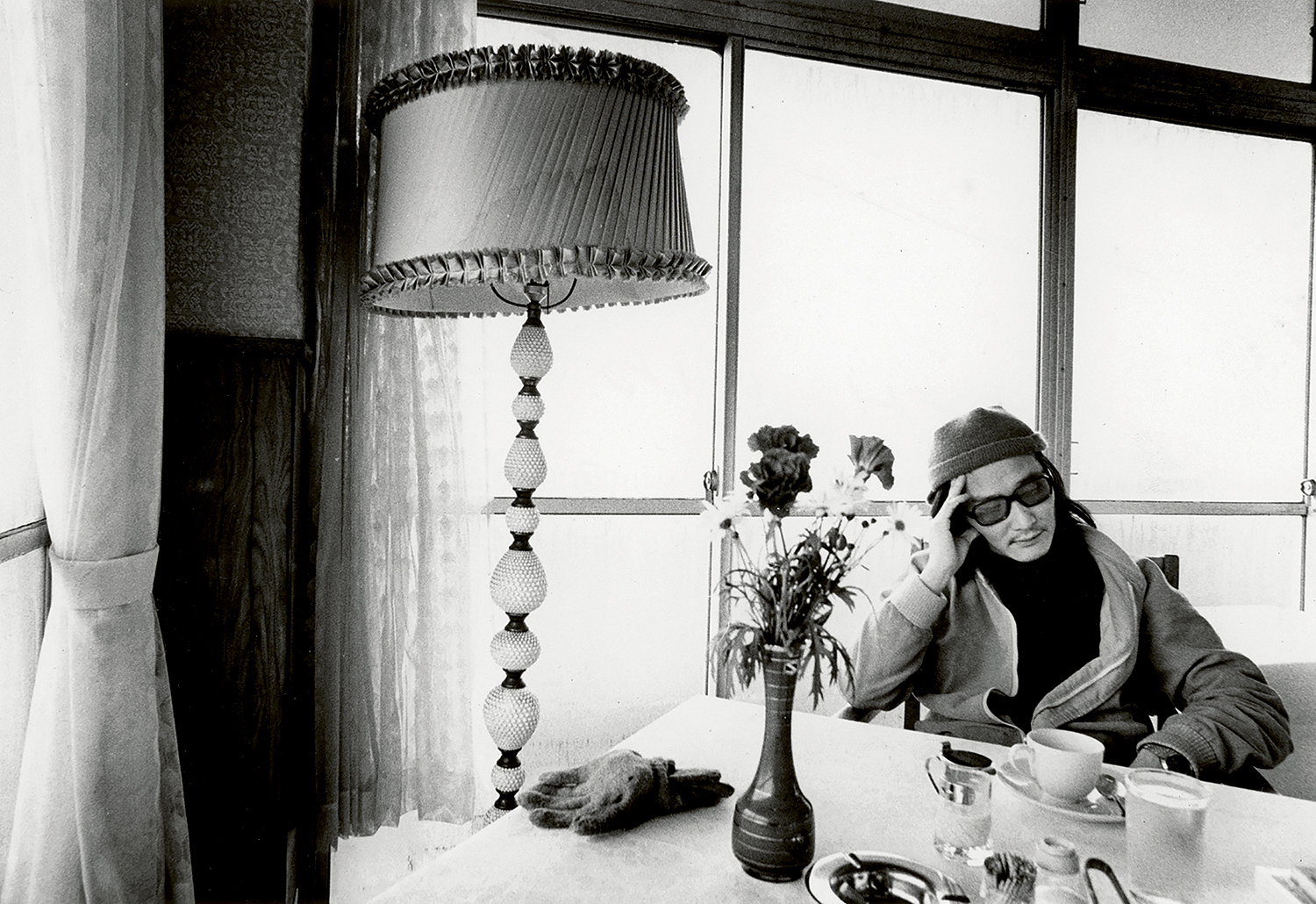

As Prichard points out, Nakahira’s approach to photography was inseparable from his politics. Provoke was founded in 1968 amid protests in Japan, France, Czechoslovakia and beyond, and questioned images as part of a wider interrogation of how we relate to the world; Nakahira published a photobook in 1970 titled For a Language to Come. The magazine and book both reject easy paths from photography to knowledge, and abandon straight documentary in favour of images further from legibility, but closer to lived experience. Both also question the power structure embedded in the camera’s one-way gaze. As Nakahira wrote in his 1972 essay The Illusion Called Document: From Document to Monument: “…Against our immediate association of the word document with an objective, impersonal viewpoint, I wanted to rethink this word through an emphasis only on the endless encounter between the world and the self.”
In his 1975 essay The Will Toward History: Surrealism’s Potential Power, Nakahira writes that surrealism was an attempt at the total liberation of the human, meanwhile, and argues, “this is why it was the first shot fired against the logic of positivism, which supports the modern system of capital”. His 1973 essay Why an Illustrated Botanical Guide? argues along similar lines, emphasising subjectivity and dialogue over insensitive, hubristic authority. “Looking cannot happen apart from the body,” he writes, adding, “As much as I may look at the world, it will always throw the gaze of things back to me at the same time.”
But Nakahira’s position also shifted over time, Abbe and Prichard point out; he became disillusioned with the new photographic language he and Provoke had tried to build after it was co-opted for advertising, and by the mid-70s was writing less politically. He also varied his subjects according to magazine commission, from avant-garde small press journals to the more established Asahi Camera. At the Limits of the Gaze includes essays from his two collections – Why an Illustrated Botanical Guide? Collected Writings on Images (1973) and Duel on Photography (1977, co-authored with Kishin Shinoyama) – and therefore “two discursive moments where he’s collecting his thoughts in very different ways, in very different contexts”, Prichard explains. He and Abbe emphasise that their book translates a fraction of Nakahira’s total output too – they knew it will often serve as an introduction, says Abbe, though they left “as many hints as possible to what else is there”.


 Estudio EA