



Pose, expression and direction
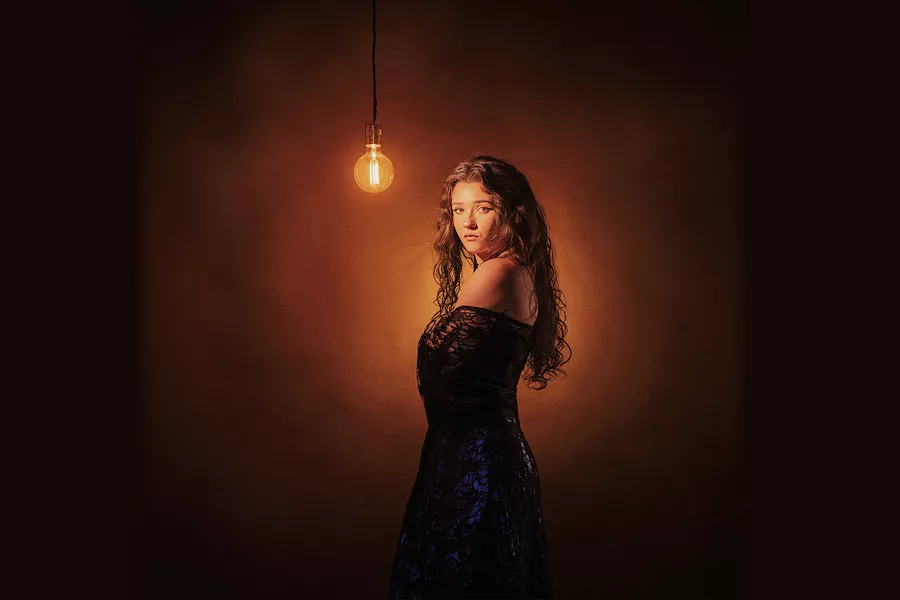
Turn your subject’s body about 45 degrees away from camera, weight settled on the back foot, then bring the head back over the leading shoulder towards the lens. The shoulder line then drops away from you, and gives the whole frame a diagonal. Chin comes very slightly down and forward, which keeps the jaw defined under a light that’s coming from above.
The eyes are everything here. I asked for the head to keep turning in small increments until the near eye was properly lit and the far eye still had a catchlight, then stopped. Getting the stillness was the hard part. We’ve known Lizzie for ten years, since her 16th birthday, and she’s smart and bubbly and very funny, so there was a great deal of laughter to work through before we could take a breath and capture a ‘moody’ image.
Step-by-step set-up guide
1: Kill every other light in the room. Studio heads and modelling lamps off, blinds down, door shut. With sources this weak, any stray ambient will flatten the whole thing before you’ve started though, of course, if you want a little fill then you might let some ambient light leak into the frame.
2: Roll out black paper and stand your subject about a metre and a half in front of it. Don’t be tempted by black velvet: it will swallow the tube light and you’ll get nothing back.
3: Hang the bulb on a long flex so that it sits camera-left of your subject, clearly above her eyeline, and bring it in close, under a metre from the face. Then walk round to the camera position and check the flex reads as a line rather than a mess.
4: Put one tube directly behind your subject so that her body hides it, and the second further back and round towards camera-right. Switch them on, set them warm to sit near the bulb, and look at the shape of the pool on the paper rather than at the tubes.
5: Adjust your camera settings and the tube output together until the paper glows the way you want, and the bulb itself is bright but not a featureless white disc. Aperture, ISO and tube power are one decision, not three.
6: Pose the body away, bring the head back and refine the head angle in small turns until the loop shadow under the nose sits where you want it and both eyes have life.
7: Shoot a frame, look at it properly and then move the bulb rather than the subject. A bare bulb is unforgiving. There’s nothing soft to hide behind, so the position has to be right rather than nearly right.
8: Check your histogram! You need to make sure the blacks haven’t completely blocked up and the highlights (the LED filaments) are the only thing blowing out to white.


 Estudio EA